Showing posts with label alternate history adventure. Show all posts

Thursday, November 3, 2022

First Chapter Review: A War in Too Many Worlds by Elizabeth Crowens


This time travel/alternate history novel is the third in The Time Traveler Professor series. Having enjoyed the first two books, Silent Meridian and A Pocketful of Lodestones, I was eager to return to the diaries of John Patrick Scott.  

I was supposed to post a full review today, but my work schedule has made reading nearly impossible. I hope to finish this book over the weekend. Fingers crossed.

BLURB: The secret diaries of John Patrick Scott pick up at the close of 1917. British intelligence sends Scott to work undercover in Berlin with his old partner-in-crime, Wendell Mackenzie, as his outside contact in Paris. Back on the Western Front, Scott discovered his ability to see the ghosts of the dead. Unsure if that’s a blessing or a curse, he takes this one-step further, employing spirits in the world of deception and intrigue. As the Russian monarchy crumbles and the Red Baron meets his final match, for Scott, true love is always beyond arm’s reach. His long-lost patrons and paramours, Sophia and Francois Poincaré, resurface but as potential enemies of the Crown.

Arthur Conan Doyle vows to retrieve his stolen time machine from H.G. Wells. Scott is still at odds with Doyle, who still refuses to publicly acknowledge his contributions for ghostwriting Sherlock Holmes, and Doyle encounters Harry Houdini in the most unlikely of places. Get ready for a wild ride. Time Traveler Professor, Book Three: A War in Too Many Worlds, pairs murder, mayhem and mysticism in a mashup where The Lost World meets The Island of Doctor Moreau.

Stay tuned for Book Four, 
The Story Beyond Time, the final book in this epic series.

COVER: The branding for these books is superb. Even though the color schemes slightly change, many of the elements remain the same. They are easily recognizable. They also catch the eye. 

FIRST CHAPTER: John Patrick Scott hears rumblings his military superiors are considering transferring him to London, so on an effort to clear up any grievances with Arthur Conan Doyle, they agree to meet. His spirit guide Finneas Fertle is along for the ride. 

KEEP READING: I am already past the first chapter if that gives you any indication.  It has been three years since I read the first two books, so I read my reviews. If I hadn't, I probably would not have recalled the cliff hanger ending in the second book that carries over into A War in Too Many Worlds. Rarely a fan of this type of ending, it serves its purpose well as the series continues, and Crowens created a riveting first chapter that drew me in right away.  

What the author did well in the first two books is create an engaging cast of characters and explore alternate histories for well-known figures. That continues from the first pages of A War in Too Many Worlds. I look forward to reading the rest of the novel.

Read an excerpt!

A street urchin, clutching a loaf of bread and followed by several irate members of Simpson’s kitchen staff, rushed toward their table just as Arthur was about to elaborate. 

“Who do we have here?” Wells asked, surprised but amused at the unexpected interruption. 

“He reminds me of one of the Baker Street Irregulars whom Holmes uses as confederates to get information on his suspects.” Arthur added.  

The boy’s cap fell on the floor. Arthur bent over and picked it up.

“Alms for the poor?” the waif asked.

“Cute kid,” Arthur said, reaching in his pocket for spare change. The kitchen staff scolded the child and swiped back the bread, but when they noticed his grubby hands caked with grease and soot, they declared it ruined and unfit for their customers and gave it back with disdain. The maître d’ caught up with the gentlemen, accompanied by his security detail, who apologized and escorted the intruder pell-mell out the door. 

In the end, Arthur was no further from his objective than whence he started. He still couldn’t prove Wells had stolen his time machine and, to make matters worse, he realized their diminutive beggar was also a sly pickpocket. His wallet, along with his cherished gold timepiece, which he hadn’t secured on a chain, was gone. Wells had to pick up the tab.


  • Publisher ‏ : ‎ Atomic Alchemist Productions LLC (August 16, 2021)
  • Language ‏ : ‎ English
  • Paperback ‏ : ‎ 310 pages
  • ISBN-10 ‏ : ‎ 1950384071
  • ISBN-13 ‏ : ‎ 978-1950384075

I received a digital copy of this book from the author. This First Chapter Review contains my honest opinions, which I have not been compensated for in any way.


Wednesday, November 6, 2019

Book Reviews: Silent Meridian and A Pocketful of Lodestones by Elizabeth Crowens

If you enjoy novels that defy categorization, Silent Meridian, the first book in The Time Traveler Professor series by Elizabeth Crowens, might be worth investigating.

John Patrick Scott is a naïve but ambitious student studying music at the University of Edinburgh when he first meets Sir Arthur Conan Doyle. The latter's obsession with a legendary red book and the transmigration of souls brings these two men together. While most know Scott as a concert pianist, he is also a paranormal investigator and time travel professor.

Together, these men will travel through time as detailed in Scott's diaries which fill this novel.

What drew me to Silent Meridian is its time travel aspect and Sir Arthur Conan Doyle. Readers have called it steampunk or alternate history, and the book's press release adds fictional memoir to the list. This may have presented a formula reader such as myself with challenges in fully appreciating the novel. Crowens wove together a unique story that introduced alternate histories for several well-known characters, like Conan Doyle, H. G. Wells, Houdini, Jung and others, which I found rather fascinating. Scott's dreams and his initiation in to a secret society that led him to come into possession of the red book were also elements I enjoyed. I just felt confused a good part of the time. That said, I gave the second book in the series a shot, because Silent Meridian is well written, and a reader appreciates that.

Series: The Time Traveler Professor (Book 1)
Paperback: 368 pages
Publisher: Atomic Alchemist Productions LLC; 2nd ed. edition (June 12, 2019)
Language: English
ISBN-10: 1950384047
ISBN-13: 978-1950384044

Purchase Links: Amazon | Barnes & Noble | Goodreads


The second book in the series, A Pocketful of Lodestones, opens with John Patrick Scott enlisting to serve in World War I in August 1914. During basic training, he is plagued by a series of strange dreams and the odd souvenirs left behind as proof he had not simply imagined his travel. Scott is also tormented by the horrors of war and a platoon sergeant who has it in for him.

In the next book of The Time Traveler Professor series, World War I takes center stage. So, in this respect, history lovers or readers who enjoy alternative history may be more drawn to A Pocketful of Lodestones than the first book. I feel, however, that reading Silent Meridian first will help readers understand the characters and concepts better than if they pick up the second book as a stand alone.

While my confusion remained a bit of an issue with this novel, I felt disappointed with the cliff hanger ending. I'm just not a fan. Crowens creates the perfect set up for a third book, but I never like being cajoled into buying another book just to continue a character's adventures that begin in the book before it; blame television in the 70's and 80's where every issue was resolved in 30 to 60 minutes.

Still, I admire Crowens' imagination and ability to create an engaging cast of characters and explore alternate histories for well known figures. This would be a fascinating movie or television series.

Series: The Time Traveler Professor (Book 2)
Paperback: 328 pages
Publisher: Atomic Alchemist Productions LLC (August 1, 2019)
Language: English
ISBN-10: 1950384055
ISBN-13: 978-1950384051

Purchase Links: Amazon | Barnes & Noble | Goodreads

I received a free paperback copy of both books from the author. These reviews contain my honest opinions, which I have not been compensated for in any way.


Thursday, October 31, 2019

Book Spotlight: A Pocketful of Lodestones by Elizabeth Crowens

I am supposed to be posting a review today, but I'm not quite done with this one yet. I also want to post my review for the first book of this series--which I've read--at the same time. Look for it by Monday.
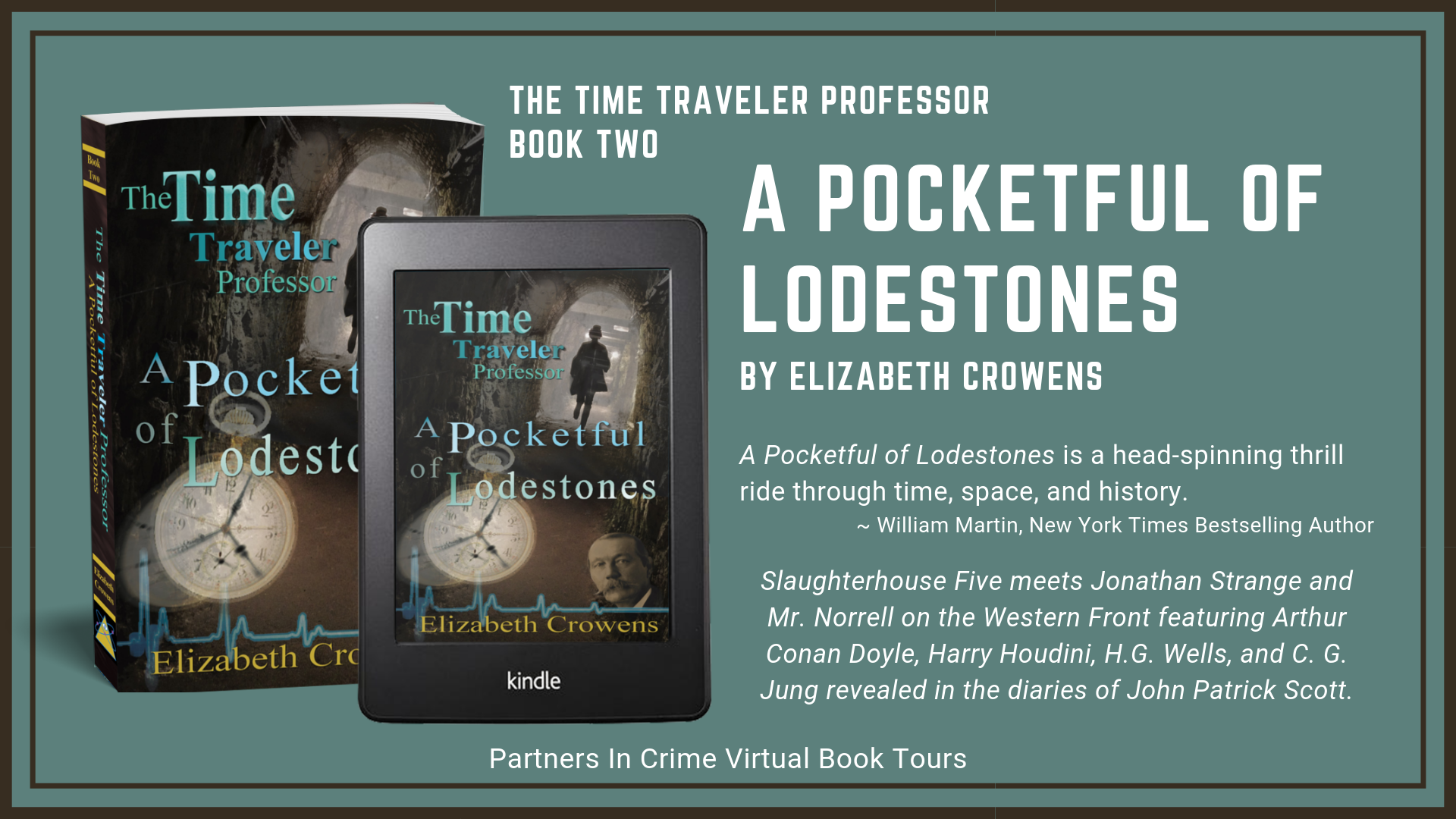

A Pocketful Of Lodestones by Elizabeth Crowens


The Time Traveler Professor, Book Two:

A Pocketful of Lodestones

by Elizabeth Crowens

on Tour October 1-31, 2019


Synopsis:
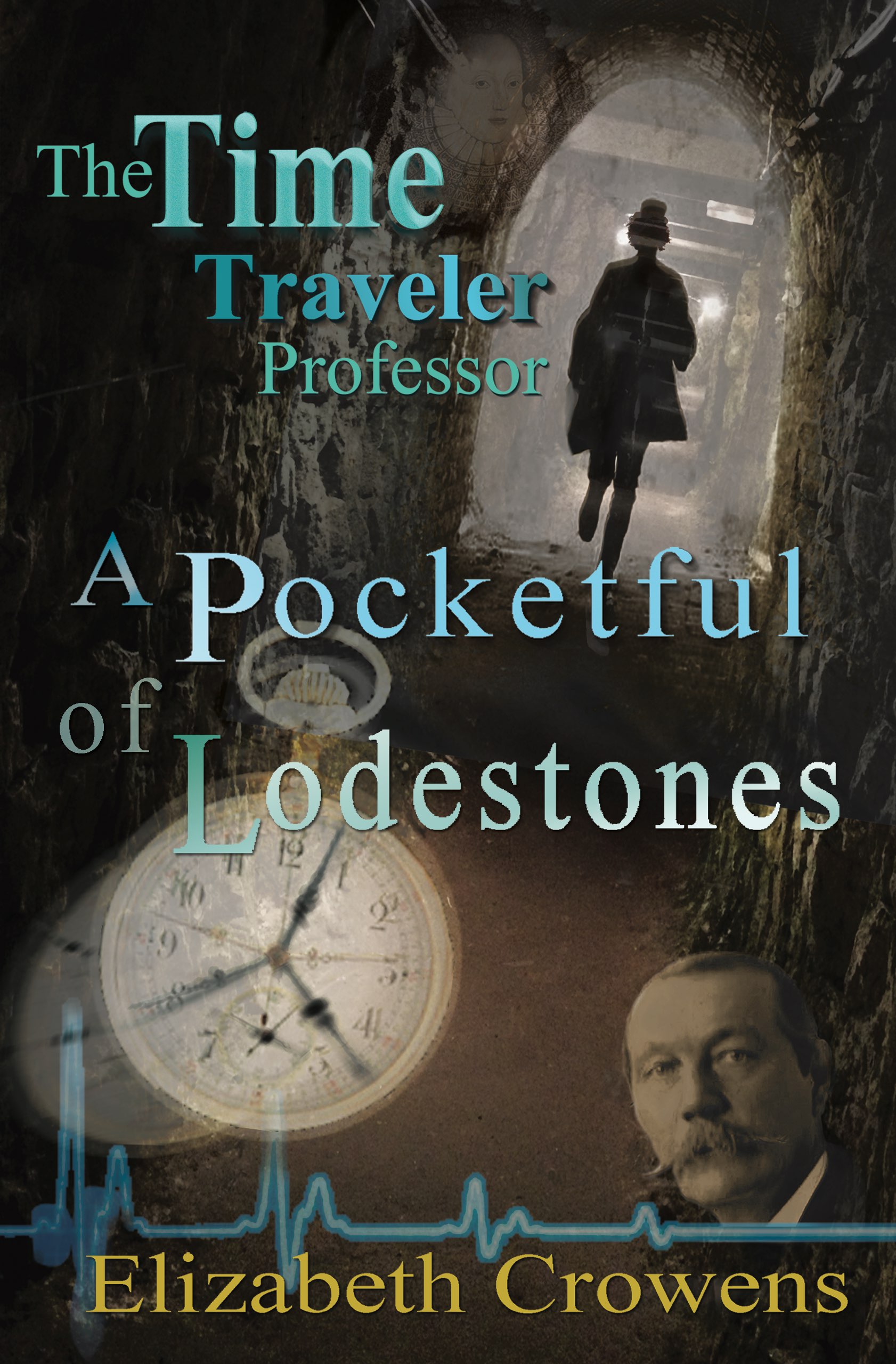

The Time Traveler Professor, Book Two: A Pocketful of Lodestones by Elizabeth Crowens
In 1914, the war to end all wars turns the worlds of John Patrick Scott, Sir Arthur Conan Doyle, H.G. Wells, Rebecca West and Harry Houdini upside down. Doyle goes back to ancient China in his hunt for that “red book” to help him write his Sherlock Holmes stories. Scott is hell-bent on finding out why his platoon sergeant has it out for him, and they both discover that during the time of Shakespeare every day is a witch-hunt in London. Is the ability to travel through time the ultimate escape from the horrific present, or do ghosts from the past come back to haunt those who dare to spin the Wheel of Karma?

The Time Traveler Professor, Book Two: A POCKETFUL OF LODESTONES, sequel to SILENT MERIDIAN, combines the surrealism of Kurt Vonnegut’s Slaughterhouse-Five with the supernatural allure of Susanna Clarke’s Jonathan Strange and Mr. Norrell set during WWI on the Western Front.


The Time Traveler Professor, Book Two: A POCKETFUL OF LODESTONES was the First Prize winner of the Chanticleer Review’s Paranormal Fiction Awards.

Book Details:


Genre: Alternate History, Mystery, Fantasy Noir


Published by: Atomic Alchemist Productions LLC


Publication Date: August 1st 2019


Number of Pages: 334


ISBN: 9781950384051


Series: The Time Traveler Professor #2


Purchase Links: Amazon | Barnes & Noble | Goodreads


Read an excerpt:


Chapter One: Kitchener’s Call to Arms


August 1914


“Have you ever killed a man before?”

I had, but close to three hundred years ago. So, I lied and just shook my head.

“Your name, son?” the recruitment officer asked.

“John Patrick Scott,” I said, with pride.

The officer handed me a card to fill out. “Write your date of birth, where you live and don’t skip any questions. When finished, bring this over to Line B.”

Born during the reign of Queen Victoria, somehow or other I managed to travel to the 23rd century, feudal Japan, and ancient China long before the Great War started. The army wanted to know all the places I had traveled, but it was doubtful that much information was required.

Since the war to end all wars commenced, recruiting centers sprang up like wildflowers. This one took over an Edinburgh public library. If unaware as to why the enthusiastic furor, one would’ve guessed the government gave away free land tracts with titles.

“Let’s see how clever you blokes are. Tell me the four duties of a soldier,” another enlistment administrator called out.

An overeager Glaswegian shouted, “Obedience, cleanliness, honesty and sobriety, sir!”

The chap next to him elbowed his side. “Takes no brains to read a bloody sign.”

Propaganda posters wallpapered the room with solicitous attempts at boosting morale. Kitchener wanted us and looked straight into our eyes. Proof of our manhood or perhaps stupidity. Queues of enthusiasm wound around the block. Impatient ones jumped the lines. We swore our allegiance to the King over a bible. As long as the war lasted, our lives were no longer our own.

Voices from men I’d never see again called out from the crowd.

“It’ll be over in six weeks.”

“Are you so sure?”

“Check out those men. All from the same cricket team. Play and die together. Medals of Valor in a blink. Local heroes with celebrations.”

“I’ll drink to that.”

A crusty old career soldier yelled out to the volunteers, “Does anyone speak Flemish?”

Suddenly the place got quiet. Then he looked at me. “Soldier, do you know anything besides the King’s English? French?”

“Fluent German,” I said. “That should be helpful.”

“Since when were you with the Bosches?”

“Fourteen years, sir. Before the war.”

“And what were you doing in enemy territory?”

“Worked as a teacher. A music professor and a concert pianist when I could get the engagements and sometimes as an amateur photographer. They weren’t our enemies then, sir.”

“Have you ever shot a rifle, son?”

“Actually, I have…”

“Find a pair of boots that fits you, lad. Hustle now. Time’s a wasting.”

The Allied and German armies were in a Race to the Sea. If the Germans got there first, then England was in danger of invasion. Basic training opened its arms to the common man, and it felt strange to be bedding alongside Leith dockworkers and farmers, many underage, versus the university colleagues from my recent past. Because of the overwhelming need for new recruits, training facilities ran out of room. The army took over church halls, local schools and warehouses in haste. Select recruits were billeted in private homes, but we weren't so fortunate.

Except for acquired muscles, I slimmed down and resembled the young man that I was in my university days except with a tad more gray hair, cut very short and shaved even closer on the sides. No more rich German pastries from former students as part of my diet. At least keeping a clean-shaven face wasn’t a challenge since I never could grow a beard. Wearing my new uniform took getting used to. Other recruits laughed, as I’d reach to straighten my tie or waistcoat out of habit despite the obvious fact that I was no longer wearing them.

While still in Scotland during basic training, I started to have a series of the most peculiar dreams. My boots had not yet been muddied with the soil of real battlefields. New recruits such as I, had difficult adjustments transitioning from civilian life. Because of my past history of lucid dreaming, trips in time travel and years of psychical experimentation I conducted both on my own and with my enthusiastic and well-studied mentor, Arthur Conan Doyle, my nightmares appeared more real than others. My concerns were that these dreams were either actual excursions into the Secret Library where the circumstances had already occurred or premonitions of developments to come.

The most notable of these episodes occurred toward the end of August in 1914. In this dream, I had joined another British platoon other than my own in Belgium on the Western Front. We were outnumbered at least three to one, and the aggressive Huns surrounded us on three sides.

Whistles blew. “Retreat!” yelled our commanding officer, a privileged Cambridge boy, barely a man and younger than I, who looked like he had never seen the likes of hardship.

We retreated to our trenches to assess what to plan next, but instead of moving toward our destination everyone froze in their tracks. Time was like a strip of film that slowed down, spooled off track, and jammed inside a projector. Then the oddest thing happened to our enemy. For no apparent reason, their bodies jerked and convulsed as if fired upon by invisible bullets over the course of an hour.

When the morning fog lifted, the other Tommies and I broke free from our preternatural standstill and charged over the top of the trenches with new combat instructions. Half of our platoon dropped their rifles in shock. Dead Huns, by the thousands, littered No man’s land long before we had even fired our first retaliatory shot!

I woke up agitated, disoriented and in a cold sweat. Even more disturbing was finding several brass shell casings under my pillow — souvenirs or proof that I had traveled off somewhere and not imagined it. I roused the sleeping guy in the next bed and couldn’t wait to share this incredible story.

“Shush!” he warned me. “You’ll wake the others.”

Meanwhile, he rummaged inside his belongings and pulled out a rumpled and grease-stained newspaper clipping that looked and smelled like it had originally been used to wrap up fish and chips.

He handed it to me with excitement. “My folks sent this me from back home.”

The headlines: “Angels sited at the Battle of Mons”

Almost as notable was the article’s byline written by my best friend from the University of Edinburgh, Wendell Mackenzie, whom I had lost track of since the war started.

He begged me to read on.

“Hundreds of witnesses claimed similarities in their experiences. There were rumors aplenty about ghostly bowmen from the Battle of Agincourt where the Brits fought against the French back in 1415. Inexplicable apparitions appeared out of nowhere and vanquished German enemy troops at the recent Battle of Mons.”

“This looks like a scene from out of a storybook.” I pointed to an artist’s rendition and continued.

“Word spread that arrow wounds were discovered on corpses of the enemy nearby, and it wasn't a hoax. Others reported seeing a Madonna in the trenches or visions of St. Michael, another saint symbolizing victory.”

“Now, I don’t feel so singled out,” I said and handed the newspaper articles back to my comrade.

For weeks, I feared talking to anyone else about it and insisted my mate keep silent. Even in wartime, I swore that I’d stay in touch with my closest acquaintances, Wendell Mackenzie and Sir Arthur Conan Doyle. It was easier to keep abreast of Arthur's exploits, because of his public celebrity. On the other hand, Wendell, being a journalist, could be anywhere in the world on assignment.

* * *

Dear Mr. and Mrs. Mackenzie,

I regret having missed Wendell when he never made it over to visit Scotland, and you wonder if someone up above watches over us when we make decisions where to go and when. In my case it was when I decided to take a summer vacation and travel to Edinburgh before the war. Those without passports or proper documentation endured countless detours and delays getting back to their respective homelands. One of Mrs. Campbell’s lodgers had been detained in France.

With nothing to return to back in Germany, I joined the Royal Scots. Military training commenced in Edinburgh, and at least they had us wearing uniforms of pants tucked into gaiters as opposed to the Highland troops who wore kilts. Although I was born and bred in Scotland, as a Lowlander that’s one outfit you’d have to force me into with much duress.

Our tasks would be in the Scots Territorial units deployed on our coastline in case of an enemy invasion. Potential threats could come from spies or submarines, but most say that the worst enemy has been the frigid wind blowing off the North Sea.

As there is always talk about combining forces and transfers, my aunt can always forward letters. It would mean more than the world to hear from Wendell saying that not only is he all right, but also in good spirits.

Yours most devoted,

Private John Patrick Scott

* * *

Dear Arthur,

In our last correspondence, I conveyed that I was unable to return to my teaching post in Stuttgart. With your tour in the Boer War as my inspiration, I joined the military. We learned the basics: how to follow commands, first aid, march discipline and training in all matters of physical fitness. My feet have been in a constant state of rebellion, since my previous profession as a pianist was a sedentary occupation.

Deployment was supposed to be along the coast of Scotland, but the army reassigned me despite first promises because of too many staggering losses on the Western Front. I requested to be part of the air corps and a pioneer in new battle technology, but my recruiting officers had other plans. Our regiment left for Ypres in Belgium. None of the Tommies could pronounce the name of this place, so everyone called it Wipers. You’re no stranger to war, but everyone has been surprised that it lasted longer than anticipated.

Yours Most Devoted,

Private John Patrick Scott

* * *

Troops from all over under the wing of the British Expeditionary Forces piled on to ships to sail out to the continent. The locals from Edinburgh didn’t expect to leave bonnie ole Scotland. They told us we’d defend our shores from foreign invasions. I’d crossed the North Sea before, but then it was a sea of hope and a new life full of opportunity when I got my scholarship to continue my musical studies in Germany, now the enemy.

I turned to the nearest stranger, hoping that a random conversation would break the monotonous and never-ending wait until we set anchor in Belgium. “How was your basic training?”

“Three months at an abandoned amusement park,” the soldier replied. “We trained for the longest time in our street clothes and were told they ran out of uniforms. Probably sent recycled ones after the first troops died. Used wooden dummy rifles until the real ones arrived. What about you?”


“We used an abandoned dance hall. Never could get used to waking at 5:30 a.m.”

“Word got around that in Aldershot soldiers had luxury facilities with a billiards room, a library, private baths and a buffet. I suspect that was for the regulars, the old-timers, not new recruits like us.”

“I should’ve enlisted elsewhere,” I grumbled, not that it would’ve made much of a difference if we’d all die in the end.

He pointed to my face and examined my flawless hands. “You don’t look like much of an outdoorsman. Pale, hairless complexion. No scars.”

“I’m a concert pianist.”

“Not much use on the Front.”

“Probably not. Excuse me, I need some air.” I bundled up in my great coat, wrapping my muffler a wee bit tighter.

Wasn’t sure which were worse — the soldiers with their asphyxiating cigarettes or numbing sleet turning into ice pellets. Hadn’t gotten my sea legs, yet. Stormy swells churned my stomach. Sweet Scotland. Lush green grass and the sky the color of blue moonstone. Never thought I’d be so sentimental. Continued staring until brilliant hues of the shoreline merged into dismal grays of a foggy horizon. In the transition from civilian to soldier, I stepped through a door of no return unless I desired to come back home in a coffin.

Chapter Two: The Other Lost World


Ypres, Belgium Late fall, 1914


A sea of strange men, but all comrades-in-arms, all recent transplants marched to their assignments and followed orders without question to who-knows-where on the way to the battlefield sites. We sallied forth, anonymous troops with a distorted sense of time and distance through the streets of has-been cities, once thriving communities. Poetry in ruination.

As we marched through the Grote Markt (Grand Market) heading out toward the Menenpoort (or Menen Gate) I didn’t expect to get an education. The soldier to my left kept talking out loud and compared notes of local tourist attractions. He was probably unaware that anyone else had overheard his comments.

“That long, distinctive building with the church hiding behind it must be the Hallen… or their Cloth Hall. There were impressive paintings on the interior walls of the Pauwels Room depicting the history of this town and its prosperous textile trade.”

“How do you know this?” I asked, trying not to attract too much attention.

“I’m a historian. Used to teach at a priory school in Morpeth.”

Perhaps I was naïve, but I asked, “Why would the armed forces recruit someone with a background in history?”

“That didn’t influence my enlistment although I’m sure it’ll come in handy somewhere. Before the war, I traveled all over Europe when time permitted. I brought original postcards with me as to what this town used to look like. It’s frightening to see the difference.”

“Your name?” I asked.

“Private Watson. What about you?”

“Not John Watson, by any chance?”

“No, Roger Watson, why?”

I shook my head thinking about Arthur and bit my lip to hide a slight smile. “Oh nothing… My name is Private Scott, John Patrick Scott.”

“What brings you to this dismal corner of the earth?”

“Ich war ein Musiklehrer. Pardon me, sometimes I break into German. I’m from Edinburgh but was living in Germany as a music teacher. Can’t be doing that sort of thing now.”

“I suppose not.”

“Roger, sorry to have eavesdropped, but it sounded so interesting. Then you are familiar with the area we just marched through?”

“That was the central merchant and trading hub of Ypres and has been since the mid-fifteenth century. On the north side over there is St. Martin’s Cathedral. You can already see the damage from German attacks.”

There was no escaping the needless destruction by aggressive enemy bombing. We continued marching forward in formation. A little way beyond the city gate, we passed by the remains of a park and children’s playground. The soldiers took a rest break and snacked on portable rations.

Many of them took off their boots and massaged their feet. Not too far away, I found a shattered brick in the rubble of what had been a schoolhouse and brought it back to where everyone was having his makeshift picnic.

Watson noticed that I kept twirling the small fragment in my hand while intermittently closing my eyes. “Scott, what are you doing?”

“Pictures form in my mind similar to movies. It’s the art of psychometry,” I replied.

“Psycho — what?” Another soldier overheard us talking.

“Sounds like something from Sigmund Freud,” one called out.

“Not at all, it’s like a psychical gift or talent. It has nothing to do with psychoanalysis.”

“What’s the point?” the first one asked.

I felt under pressure to put my thoughts into words. “I can understand what building this brick was part of when it was intact and what was here before it was destroyed.”

“That’s incredible!” Watson exclaimed. “If you are able to uncover bygone times by psychical means, I am all ears.”

When everyone else discounted my talent, Watson gave it full praise. Others became impatient and weren’t interested in our sidebar history lesson.

“Can you use those skills beyond inanimate objects?” one soldier asked.

“Find me an object, someone’s former possession,” I said.

Another soldier found a broken pocket watch not far from a trampled garden. He tossed it over, and I caught it with both hands. When I closed my eyes, the images materialized in my mind’s eye.

“A loving grandfather was reading to his grandchildren from an illustrated story book. He was balding. Wore spectacles. Had a trimmed white beard.

“‘Time for bed,’ he said, looking at his watch. Tick tock, tick tock. It was a gift from his father.

“He kissed each grandchild on the forehead as they scampered off. Two girls, one boy, all in their nightgowns. The tallest girl was a redhead with… pink ribbons in her long, curly hair. Then the bombs dropped. Fire. The roof collapsed. All was lost. Then… then… Oh my God!”

“Scotty, what’s wrong?” Watson asked.

I looked at the blank faces around me. “You don’t see him?”

Watson was baffled. “See who?”

“That grandfather,” I said, horrified and clutching onto that timepiece. His ghost was standing right in front of me!

Then I realized that no one else was capable of seeing him. Inside, I panicked until my frozen fingers let go of the watch, and it tumbled into the dirt. That’s when his phantasmal form vanished, but there were still indelible memories impressed upon the ether that refused to fade with the passage of time.

Warning bells tolled from a nearby church. “Quick, run for cover!” our commanding officer shouted.

Double-time over to shelter. Incoming bombs whistled and boomed in the distance. Civilians followed, carrying their most precious possessions, also fleeing for their lives.

The sanctuary already suffered from shell damage that left large gaping holes in its roof. Birds nested above the pulpit. Cherished religious statuary had been knocked over and broken. Several nuns rushed up and motioned the way for us to take refuge in the basement. We joined the crowd of scared families, members of the local community.

“Isn’t Britain giving them haven?” I asked Watson. “I thought most of the civilians evacuated by now.”

“There are still the ones who want to hold out,” he explained. “Wouldn’t you if your entire life and livelihood were here for multiple generations? That’s why they’re counting on us, but the Germans are relentless. Ypres is right on the path of strategic routes to take over France.”

When several farmers brought over their pigs and chickens, our retreat began to resemble a biblical nativity scene. From inside the cellar, we could hear the rumble of the outside walls collapsing.

“We’ll be trapped!” People yelled out in panic.

A group of sisters prayed in the corner. Our trench diggers readied themselves to shovel us out if it came to that. One terror-stricken woman handed me a screaming baby.

“I found him abandoned.” At least that’s what I thought she said in Flemish, but none of us could understand her. Confused and without thinking, I almost spoke in Japanese, but that would’ve been for the wrong place and an entirely different century during a different lifetime.

“What will I do with him?” I said to her in German, but she didn’t comprehend me either. I couldn’t just place him down in a corner. We’d be marching out in a matter of minutes.

I approached a man with his wife and three other children. First I tried English, then German, random words of French, and then I tried Greek and Latin from my school days. Finally I resorted to awkward gestures to see if he’d take the child. But he shook his head, gathered his brood and backed off.

Troops cleared a path out of the cellar. We needed to report to our stations before nightfall.

“Sister, please?” I begged one nun, interrupting her rosary. To my relief, she took the infant.

“Oh Mon Dieu!” I cried out in the little French that I knew. “Danke, thank you, merci boucoup.” Then I ran off to join the others.

Watson slapped me on the back. “Looked like you were going to be a father, mate.”

“Not yet. Got a war to fight,” I replied.

***

Excerpt from The Time Traveler Professor, Book Two: A Pocketful of Lodestones by Elizabeth Crowens. Copyright © 2019 by Elizabeth Crowens. Reproduced with permission from Elizabeth Crowens. All rights reserved.


Author Bio:


Elizabeth Crowens

Crowens has worked in the film and television for over twenty years and as a journalist and a photographer. She’s a regular contributor of author interviews to an award-winning online speculative fiction magazine, Black Gate. Short stories of hers have been published in the Bram Stoker Awards nominated anthology, A New York State of Fright and Hell’s Heart. She’s a member of Mystery Writers of America, The Horror Writers Association, the Authors Guild, Broad Universe, Sisters in Crime and a member of several Sherlockian societies. She is also writing a Hollywood suspense series.

Catch Up With Our Author On:


elizabethcrowens.com 

Goodreads 

Bookbub 

Twitter & Facebook!


Tour Participants:


Visit these other great hosts on this tour for more great reviews, interviews, guest posts, and giveaways!


Giveaway!!!

This is a rafflecopter giveaway hosted by Partners in Crime Virtual Book Tours for Elizabeth Crowens. There will be 8 winners. One (1) winner will receive an Amazon.com Gift Card. Seven (7) winners will each receive A Pocketful Of Lodestones by Elizabeth Crowens (eBook). The giveaway begins on October 1, 2019 and runs through November 2, 2019. Void where prohibited.


a Rafflecopter giveaway


Get More Great Reads at Partners In Crime Virtual Book Tours


Thursday, September 19, 2019

Book Spotlight & Giveaway: Silent Meridian by Elizabeth Crowens


Silent Meridian by Elizabeth Crowens Banner


The Time Traveler Professor, Book One:

Silent Meridian

by Elizabeth Crowens

on Tour August 18 - September 21, 2019


Synopsis:


The Time Traveler Professor, Book One: Silent Meridian by Elizabeth Crowens

Sir Arthur Conan Doyle is obsessed with a legendary red book. Its peculiar stories have come to life, and rumors claim that it has rewritten its own endings. Convinced that possessing this book will help him write his ever-popular Sherlock Holmes stories, he takes on an unlikely partner, John Patrick Scott, known to most as a concert pianist, but a paranormal investigator and a time traveler professor to a select few.

Like Holmes and Watson trying to solve a mystery, together they explore lost worlds and their friendship is tested to the limits when they go back in time to find it. Both discover that karmic ties and unconscionable crimes have followed them like ghosts from the past, wreaking havoc on the present and possibly the future.

The Time Traveler Professor, Book One: SILENT MERIDIAN reveals the alternate histories of Conan Doyle, H.G. Wells, Houdini, Jung and other luminaries in the secret diaries of John Patrick Scott, in an X Files for the 19th century. First Prize winner of Chanticleer Review's Goethe Award for Turn-of-the-Century Historical Fiction and First Prize for Steampunk in the Independent Press Awards. Stay tuned for A POCKETFUL OF LODESTONES; Book Two in the Time Traveler Professor series by Elizabeth Crowens.

Book Details:

Genre: Alternate History, Mystery, Fantasy Noir

Published by: Atomic Alchemist Productions LLC

Publication Date: June 12th 2019

Number of Pages: 384

ISBN: 9781950384 (ISBN13: 9781950384044)

Series: The Time Traveler Professor #1

Purchase Links: Amazon | Barnes & Noble | Goodreads


Read an excerpt:


Edinburgh, 1898


Scotland was just barely crawling its way out of the nineteenth century. I was a naïve, but ambitious student studying music at the University of Edinburgh hurrying over to meet Arthur Conan Doyle, the man who would change my life forever.

“John Patrick Scott, sir,” I said and approached Mr. Doyle, who was already seated at a back corner table of the Deacon Brodie, the pub that inspired the Strange Case of Dr. Jekyll and Mr. Hyde.

I extended my hand to greet him and removed my rain-soaked hat, while my overcoat slipped out of my hands and fell on the floor by accident. It was still hard to believe that good fortune finally brought us together, but we were both nervous. “Mr. Conan Doyle, or should I call you Doctor Doyle?” I was unsure how to address him.

Doyle scrutinized me from top to bottom as he signaled the waiter. “John, call me Arthur.”

“Sir, I’m so honored that you agreed to discuss this matter. Perhaps you can enlighten me in a way that I’ve failed to comprehend.”

I wanted to ask him about my unusual turn of events straight away but he caught me off guard and was dead set on pulling me into the swift current of an unexpected conversation.

“Can I assume you believe in the transmigration of souls?” he asked.

“Until now, I haven’t given it a lot of thought,” I said, unsure as to which direction he was leading.

“Did you ever read those books about that Swiss doctor who felt his body and soul had been taken over by a Benedictine monk? That presented a curious case. He claims that he was approached by the spirit of an elderly monk before he died, and that the monk needed to rent his body to continue his spiritual mission.”

“Rent?” I choked in disbelief.

“We truly don’t take anything with us when we pass on, do we? This monk knew he was dying and therefore needed to replace his physical body with something more youthful and vital.”

“That’s incredible. It debunks the theory that you need to die and be reborn as an infant to carry on your spirit.”

Mr. Doyle had the tinge of excitement in his voice.

“John, here’s another instance. I’ve had my suspicions about a famous musician who had an obsession about a notorious and controversial mystic. You’d surmise by his overwhelming attraction to that person he might’ve been him in a previous lifetime, but facts were clear he was born three years before the mystic died. My understanding is the mystic was aware he didn’t have long in his present incarnation. Therefore he made plans for some sort of partial soul transference while he was still alive to imprint his essence upon the child. That would’ve allowed him to carry on and accomplish unfinished business, which couldn’t have been executed otherwise. Essentially he had the ability of being two places at once.”

“Sounds more like Spiritualism,” I replied.

“Honestly, John, I don’t think there are any steadfast rules when it comes to this matter. That’s what makes it so intriguing.”

I sensed he had a secret agenda.

Doyle reloaded his churchwarden pipe with fresh tobacco and continued, “This is not at all like anything you’ve ever read from H.G. Wells or Jules Verne. We’re poking holes in every treatise written on the subject — the idea of being able to reincarnate a part of yourself while you are still alive into another soul.”

Our conversation was quickly becoming like a speeding train ready to jump the tracks. Realizing this, Doyle slowed down the pace and took a deep breath. He carefully composed his next statement.

“Fiction it may seem to be but it’s not hocus pocus. Don’t you also find it strange that you somehow found yourself initiated into a mystical order on a commuter train bound from London to Edinburgh when the instigators kept on mistaking you for me? There are no accidents.”

I became silent for a moment, stalling for time as I slowly raised my glass of ale to my lips. As soon as I fished a small red book out of my coat pocket and placed it on the table in front of us Arthur eyed it intently. It had been the source of intrigue, which led me to Doyle in the first place and piqued his curiosity as much as it did mine.

“Could I have done something terrible in my youth that caused this to happen?”

“You have no recollections, John?”

“I remember so little of my childhood. I wish I could.”

“You’re a smart young man. I’m sure you’ll come up with a clever deduction.”

Mr. Doyle paused to relight his pipe. He had an unnerving look in his eye, which I vainly tried to read into, but he took me for a spin when he brought up the next topic.

“On another note, John, have you ever considered that people are capable of communicating without speech, and I’m not talking about writing letters?”

“Pardon me?”

“Imagine communicating by mere thoughts. I’ve always wanted to experiment with someone open to these concepts. God knows — my brothers at the Society for Psychical Research certainly talk enough about it. My wife, Touie, has been an unwilling subject and is not the most objective choice.”

I looked at him, somewhat perplexed. “Are you asking me to accurately guess what you’re thinking?”

“Come now. We’ll play a game. I’ll form an image in my mind, and for the next minute I will try to project it into yours. Clear your thoughts of any distractions and be as receptive as possible,” he explained.

As much as I tried, I couldn’t have been more preoccupied. Images of that fateful event flashed through my brain. My recollections revealed my rain-soaked train ticket. I kept arguing with the steward about putting me in the wrong cabin. An erroneous judgment had been made when three strangers insisted I was Arthur. We were so different in physical appearance. He was a large, athletic man with a distinguished moustache. On the other hand, I had baby smooth skin and couldn’t grow facial hair to save my life. I was nearly twenty years younger and much shorter with wild auburn hair that resembled Maestro Beethoven’s with the exception of premature strands of gray.

So why was I singled out? Was there laudanum in my brandy? Details spun like a whirlwind. I must’ve been in a drug-induced stupor but I was initiated into some secret Masonic-like society, and when it was all over those mysterious men were gone. What remained were an engraved silver ring on my finger and an ominous red book on the seat beside me.

“Looks like you’ve seen a ghost.” Arthur broke my trance and realized my thoughts had been elsewhere.

“I felt like I had.” Barely able to articulate, I tried to tame my wild mane in place. Visions faded in and out. Timelines jumped. So I gulped down another swig of ale to focus on the present.

Arthur leaned in closer. “I can see you’re still worried about that event on the train. Those men have been after me for some time. Why? It’s hard to fathom. I’ll dilly dally with notions here and there about Sherlock Holmes and his partner, Watson, who fancy themselves as detectives. Me? I’m just a simple doctor and writer with interests in Spiritualism trying to find scientific explanations for the unknown.”

“Arthur, what would anyone want with an unassuming music student like me?”

“Personally, I don’t think this was A Case of Identity,” Arthur replied with a smile.

Obviously he meant to say my dilemma was not a case of mistaken identity, not the name of one of his famous Sherlock stories. He was pleased I caught the humor of his play on words.

“Perhaps it has something to do with that book,” he said pointing to the one I brought.

“I’m concerned it’s dangerous, that it’s a curse. I wish I had never found it.” I shoved it back into my pocket and drained my glass.

* * *

One week later as I was returning home from school, my landlady, Lydia Campbell, yelled from the kitchen as I trudged my muddied shoes through the front door of her boarding house. “John, a letter from Undershaw arrived for you today! I wonder whom it could be from? You don’t know anyone from Undershaw, do you?”

Oh, yes I did. I grabbed the letter and ran upstairs so fast I nearly tripped on my muffler and fell on my face. I poured myself a glass of port to calm my nerves, doffed my wet garments and sank into my most comfortable brass-studded leather chair I affectionately named my thinking chair, where I created many a melody in my head, could think deep thoughts, and drift off to dreamland.

* * *

Dear John,

I wholeheartedly enjoyed our conversation at the Deacon Brodie and kept my promise of a prompt reply. By now, you are well aware of my passion to explore the realms of Spiritualism and related paranormal phenomena far surpasses any personal interests involved with Sherlock Holmes. Public demand for my writing, however, exerts a strain on how much I can overtly reveal to even my most trusted colleagues. Whenever I indulge in any activity, be it a simple séance, investigating a revered medium or attending a meeting of the British Society for Psychical Research, it never fails to raise the eyebrows of my wary publishers and critics. It’s God’s honest truth that I believe in many of these inexplicable accounts. Even my father painted beautiful renditions of fairies, which I trust he witnessed with his own eyes. The betterment of mankind rests on embracing such theories once they are proven to exist by the scientific community. Thus, I’ll have to continue more controversial and debatable endeavors in utmost secrecy, or at least for the time being until more evidence can be brought to light.

Since you seem to be an open-minded young man who has already experienced some effects of the preternatural, this is my proposal: At midnight every night, we should conduct a variety of remote operations with the primary purpose of communicating through means of telepathy. Since I have a tendency to travel, we’ll have to make some sort of adjustment to take into account the different time zones. Of course, you must share this secret with nobody. Besides us, only my wife will know, although she will not participate.

When you shared the account of the strange commuter train incident that was enough to convince me that you would be the perfect partner for this private undertaking. Most assuredly, there was something you did in the past in the realm of the arcane to warrant such a chain of events. That was not mere happenstance, and now since you possess that enigmatic red book, I’m sure it will affect your life in ways you’ve never imagined.

My intentions have been to perform similar trial and error enterprises with Harry Houdini, a rising star whose stage performances have been astounding audiences, but his busy schedule has made it nearly impossible to coordinate such engagements with any sort of regularity. One of these days we’ll catch up. Meanwhile, I collect whatever news comes from across the herring-pond. At one point, he and I will develop a special relationship based on mutual interests.

Regarding the two of us, however, we’ll back up our observations with letters or telegrams as often as possible as proof of results, but those must be destroyed as soon as they are read. Once again, I cannot over emphasize the importance of confidentiality. Regardless, we must keep a faithful agreement, as skill will come with practice.

If you are willing to put aside any apprehensions regarding trains, I’ll pay for you to travel down to Undershaw and visit me on weekends whenever possible. My driver can meet you in London at a pre-arranged time. You’ll stay in one of our guest bedrooms, and as long as you don’t mind the children and can tolerate what our kitchen staff provides, you’ll be well taken care of. That’ll give us the opportunity to expand our repertoire and commence further psychical experimentation with ectoplasm, spirit photography and astral projection. And bring the red book. I’d like a chance to look at it.

I’ve also desired a partner to accompany me for ghost sightings and occult investigations. For all we know with the knowledge gained, we might even break through the barriers of time. That would certainly give Bertie (H.G. Wells) a shock to the senses, proving his imagination does not merely dwell in the realm of fiction. We’ve been at odds on this topic for years.

Regarding telepathic technique, I can only suggest you conduct yourself in a way as you see fit. Personally, I don’t give credence to things like magical amulets, but if it helps to have an etheric link, use this letter you hold in your hand, as it contains my heart, soul and signature with a drop of blood, which I added to the ink. You might wish to reciprocate.

Let’s raise our glasses to honor the quest of conquering the unknown.

Arthur Conan Doyle

* * *

So, Arthur was serious when he first brought up the subject. When he and I left the pub, I really didn’t know what to think. After all, he was a famous author, and I was merely a student. What possessed him to choose me for such an engagement?

I shuffled through my schoolwork to find my pen and ink and a fresh sheet of paper. Blood, I needed blood. Ah, my razor! That would work. I fetched my shaving kit and winced as I drew a few drops. I scribbled a swift, affirmative reply with the blood-tainted ink, mailed the letter the following day and looked forward to our first otherworldly encounter.

***

Excerpt from The Time Traveler Professor, Book One: Silent Meridian by Elizabeth Crowens. Copyright © 2019 by Elizabeth Crowens. Reproduced with permission from Elizabeth Crowens. All rights reserved.


Author Bio:

Elizabeth Crowens


Crowens has worked in the film and television for over twenty years and as a journalist and a photographer. She’s a regular contributor of author interviews to an award-winning online speculative fiction magazine, Black Gate. Short stories of hers have been published in the Bram Stoker Awards nominated anthology, A New York State of Fright and Hell’s Heart. She’s a member of Mystery Writers of America, The Horror Writers Association, the Authors Guild, Broad Universe, Sisters in Crime and a member of several Sherlockian societies. She is also writing a Hollywood suspense series.


Catch Up With Our Author On:


Tour Participants:


Tour Participants:


Visit these other great hosts on this tour for more great reviews, interviews, guest posts, and giveaways!


Giveaway!!!:


This is a rafflecopter giveaway hosted by Partners in Crime Virtual Book Tours for Elizabeth Crowens. There will be eight(8) winners. One (1) winner will receive an Amazon.com Gift Card and seven (7) winners will each receive Silent Meridian by Elizabeth Crowens (eBook). The giveaway begins on August 18, 2019 and runs through September 23, 2019. Void where prohibited.

a Rafflecopter giveaway ;


Get More Great Reads at Partners In Crime Virtual Book Tours


Thursday, April 11, 2013

Book Spotlight and Giveaway: Saving Jackie K by L.D.C. Fitzgerald


The First Lady in Danger?

Jump into the past to save her!

Enter an upside-down world where Soviet henchmen botched their mission to eliminate John F. Kennedy fifty years ago, slaying his wife Jackie instead. The unthinkable crime incites Americans and triggers an unending war with Russia.

In present day, as the two superpowers teeter on the brink of mutual destruction, a team of outlaws discovers a way to jump through time. The wisecracking felons decide to take matters into their own hands by traveling back to 1963 to save Jackie K. To fix the future, they must right the wrongs of the past.

But, their mission may go awry . . .

(Formerly titled Destination Dealey.)


L.D.C. Fitzgerald is the author of blockbuster novel, SAVING JACKIE K, a thrilling adventure to save the First Lady. In writing a story with an unexpected twist on the Kennedy Conspiracy, Fitzgerald relentlessly researched the facts regarding the JFK assassination, and wove them into a fictional world. The author even consulted with renowned conspiracy experts, and scouted the hallowed grounds in Dallas.

Where does the fact end and the fiction begin?
"Everything in my novel is true, except the stuff I made up." - L.D.C. Fitzgerald

Visit the author online at http://www.savingjackiek.com/ where you can read an excerpt from the book.

Available in a Kindle version for only 99 cents or pick up your paperback copy here!

Enter for your chance to win a $50 Amazon e-Gift card!

If the Rafflecopter form doesn't load, visit the book's tour page at http://worldwindvirtualbooktours.weebly.com/1/post/2013/04/saving-jackie-k-book-giveway.html for details on how you can enter.

a Rafflecopter giveaway


Monday, February 11, 2013

Book Spotlight and Giveaway: A New Birth of Freedom: The Translator by Robert G. Pielke


Noam Chomsky argues that communication with aliens would be impossible. Stephen Hawking argues that it would be extremely unwise even to try. What if it were absolutely necessary to do so? This question arises with extreme urgency at the Battle of Gettysburg in 1863, in this time-travel, alternate-history trilogy, A New Birth of Freedom.

Excerpt Link to Prologue: http://www.whiskeycreekpress.com/chapters/ANewBirthOfFreedom_RobertPielke.shtml


Prices/Formats: $16.95 paperback, $4.99 ebook
Pages: 394
ISBN: 9781611605426
Publisher: Whiskey Creek Press
Release: November 1, 2012

Amazon paperback buy link ($16.95):
http://www.amazon.com/dp/1611605423?tag=tributebooks-20

Whiskey Creek Press paperback buy link ($16.95):
http://www.whiskeycreekpress.com/store/index.php?main_page=product_info&products_id=1058&zenid=b7536170f2c9de1f7674533bcb734028

Kindle buy link ($4.99):
http://www.amazon.com/dp/B00A0BTCO4?tag=tributebooks-20

Nook buy link ($4.99):
http://www.barnesandnoble.com/w/a-new-birth-of-freedon-robert-g-pielke/1113729034?ean=2940015901757

Whiskey Creek Press ebook buy link ($4.99):
http://www.whiskeycreekpress.com/store/index.php?main_page=product_info&products_id=1058&zenid=b7536170f2c9de1f7674533bcb734028


Robert Pielke, a native of Baltimore, Maryland, now lives in Claremont, California. He earned a B.A. in History at the University of Maryland, an M. Div. in Systematic Theology at the Lutheran Theological Seminary at Gettysburg, and a Ph.D. in Social Ethics from the Claremont Graduate School.

He taught on ground and online for countless years at George Mason University in Virginia, El Camino College in California and online for the University of Phoenix. Now happily retired from “the job,” he is doing what he always wanted to do since he wrote his first novel at ten in elementary school. It was one paragraph, three pages long and, although he didn’t know it at the time, it was alternate history.

His academic writings have been in the area of ethics, including a boring academic treatise called Critiquing Moral Arguments, logic, and popular culture. Included in the latter is an analysis of rock music entitled You Say You Want a Revolution: Rock Music in American Culture. He has also published short stories, feature articles, film and restaurant reviews. His novels include a savagely satirical novel on America and its foibles, proclivities and propensities, Hitler the Cat Goes West, and an alternate history, science fiction novel, The Mission.

Most recently, he has updated and revised his book on rock music, which is being republished by McFarland & Co.

He swims daily, skis occasionally, cooks as an avocation, watches innumerable movies, collects rock and roll concert films, is an avid devotee of Maryland crabs and maintains a rarely visited blog filled with his social and political ravings. His favorite film is the original Hairspray; his favorite song is “A Day in the Life”; his favorite pizza is from the original Ledo Restaurant in College Park, MD; and he is a firm believer in the efficacy of “sex, drugs and rock and roll.” Somehow his family and friends put up with him.

Robert G. Pielke's Web Site:
http://www.robertgpielke.com/

Robert G. Pielke's Facebook:
http://www.facebook.com/#!/robert.pielke

Robert G. Pielke's Twitter:
http://twitter.com/rpielke

Robert G. Pielke's YouTube:
http://www.youtube.com/user/rpielke

Robert G. Pielke's Goodreads:
http://www.goodreads.com/author/show/990626.Robert_G_Pielke

A New Birth of Freedom: The Translator Goodreads:
http://www.goodreads.com/book/show/16137362-a-new-birth-of-freedom

Tribute Books Blog Tours Facebook:
https://www.facebook.com/pages/Tribute-Books-Blog-Tours/242431245775186

A New Birth of Freedom: The Translator (Book 2) blog tour site:
http://anewbirthoffreedom-thetranslator.blogspot.com/

A New Birth of Freedom: The Visitor (Book 1) blog tour site:
http://anewbirthoffreedom-thevisitor.blogspot.com/


Enter for your chance to win a FREE electronic copy of A New Birth of Freedom: The Translator using the Rafflecopter form below. Good luck!


a Rafflecopter giveaway


Monday, October 17, 2011

Interview: Daniel Sullivan, Author of The Greatest Patriot

Joining us today is Daniel Sullivan, author of The Greatest Patriot.

After graduating from Oregon State University Dan worked for three years in Seattle and Portland, Oregon before quitting his job and spending three months backpacking around Europe in 1990. Upon returning from Europe, Dan moved to Boise, Idaho where he went to work in the Real Estate industry.

He earned his Scuba Dive Master certification and spent years traveling to destinations such as Fiji, Belize, Mexico, and throughout the Caribbean. Dan and his wife Amy enjoy the incredible natural wonders of Idaho and the Pacific Northwest with their two children.

Welcome to The Book Connection, Dan. It's wonderful to have you here.


Where did you grow up?

La Grande, Oregon…a idyllic little town nestled in a beautiful valley in Northeastern Oregon.

What is your fondest childhood memory?

In the winter, the city would block off Oak Street hill, a few blocks from our house. My brothers and I would sled down that hill over and over again until we were frozen. Then we would go home, warm up and do it over again. Sledding after dark was especially fun!

When did you begin writing?

I began writing short stories as soon as I could write. I wrote funny stories for my classmates and funny letters to friends and girls I liked. I remember telling stories before I could write.

Do you write during the day, at night or whenever you can sneak a few moments?

I like to get up early and write. After about 8 pm, I’m toast.

What is this book about?

It’s a “What if”. I have always wondered what the world would look like if JFK hadn’t died in ’63…I simply changed that question to a statement, the world looks as it does today because he didn’t die in 1963.

What inspired you to write it?

I wanted to write an alternate ending to the tragedy of JFK’s death. Wouldn’t it have been great to have been there and be able to yell “duck!” before the shooting started.

Who is your favorite character from the book?

You can’t help but love Hal Rumsey, the Secret Service agent who was assigned to JFK for all those years after 1963. But I really like Demetrius, the island’s little caretaker who has a wonderful sense of duty and a unique sense of humor.

Are you a member of a critique group? If no, who provides feedback on your work?

I’m not a member of a critique group. I have a large number of friends who provided great feedback throughout the writing process. I feel sorry for them, reading the first half of the book and having to wait for me to write the second half

Who is your favorite author?

Probably Clive Cussler. I like Tom Clancy and Dan Brown as well.

Do you have an agent or are you looking for one?

Neither. I wouldn’t have a problem using an agent, but I didn’t see any reason to beg somebody to read my book and represent me when I could do it myself.

Was the road to publication smooth sailing or a bumpy ride?

Once I decided to self publish, it was pretty smooth sailing.

If you knew then, what you know now, is there anything you would have done differently?

Not that I know of….can I answer this question again in a year or two?

Where can readers purchase a copy of your book?

Amazon, Barnes & Noble, all the e-readers or on my website http://www.thegreatestpatriot.com/

Do you have a video trailer to promote your book? If yes, where can readers find it?

On the website!

What is the best investment you have made in promoting your book?

The investment of time I’ve put into Facebook, Twitter, and being active on relevant blogs

What is one piece of advice you would like to share with aspiring authors everywhere?

If you are going to write a book that you want to sell, write something that is interesting. People will buy books that interest them, they won’t necessarily buy a book that is of interest just to you. I sat next to a kid on a flight a while back who was hoping to sell a book full of stories about he and his friends…but he couldn’t tell me what was unique about his group. When I got off the plane he had bought one of my books but I still wasn’t sure what he was trying to sell. Think sales first!

What is up next for you?

I’m just putting the finishing touches on a novel I wrote a few years ago, a sailing and drinking adventure (two things I know quite a bit about) that takes place in the Caribbean. I’m also about 1/3 of the way finished with the follow up to The Greatest Patriot. Jose Telleria is in a lot of trouble!

Is there anything you would like to add?

There is a book in everybody. If you want to write, sit down every day and write 250 words. After a year you will have a 365 page book. It’s easier than it seems.

Thanks for spending time with us today, Dan. We wish you the best.

Tuesday, July 21, 2009

What if? - Pat McDermott and A Band of Roses


Today's guest blogger is Pat McDermott, author of the alternate history adventure novel A Band of Roses.

A Band of Roses is an alternate history adventure set in modern day Ireland. The "what if" premise of the story supposes that Irish High King Brian Boru survived the Battle of Clontarf in 1014 A.D. and founded a dynasty that rules Ireland to this day.

Crown Princess Talty Boru, the daughter of the current King Brian, is the heir to the throne, though she wishes she weren’t. She’d prefer to pursue a military career, but she’s resigned to her royal fate until England’s Prince Geoffrey seizes a tiny Irish island in the North Atlantic and the oil-rich ocean bed around it. Geoffrey plans to return the island to Ireland in exchange for oil wells in the Irish sea. He proposes a conciliatory treaty that would marry Talty to the unbalanced young English King. Talty agrees, as the terms demand that she relinquish her title as heir to the throne. She believes she’s free of her duties as crown princess, but a murder attempt on her wedding night turns her life upside down.

Multiple attempts on Talty’s life force King Brian to send her away to protect her, though he unwittingly sends her into further danger. From Japan to California, Talty must hide her true identity until her elders can set things straight. She can’t disguise her ingrained training as one of Ireland’s ancient Fian warriors, however.

Her recruitment into International Security Forces’ top secret Peregrine Project allows her to visit strange worlds, one an eleventh century Ireland preparing for the Battle of Clontarf. She finds romance and adventureand brings back a discovery worth more than any oil well, yet all she wants is to return to her family and her lifelong friend and protector Neil Boru, the adoptive cousin she secretly loves and can’t have—or so she thinks. Talty’s warrior cousin has a secret of his own, one that emerges as the Boru clan works with England's MI6 to thwart an invasion of Ireland and bring Talty home.

What If? by Pat MacDermott

From time to time, most of us wonder how life might have turned out if we’d had richer parents, attended another school, married a different person. Historians have asked similar questions concerning the outcome of world events. What if the Roman Empire hadn’t fallen? What if the American Revolution had failed? What if Germany had won World War II?

Hold those thoughts for a moment, please. As a second generation Irish American, I’ll never know what it is to be truly Irish. I only have the stories my grandparents told, the songs they sang, the letters from siblings and cousins they never expected to see again. My childhood vision of Ireland was one of magical legends and ancient kings, banshees and leprechauns, rebellions and heroes. When at last I saw the real Emerald Isle, the palm trees astonished me. My grandparents never mentioned palm trees!

I longed for the Ireland I knew through song and story. My aunts had assured me our family had descended from Irish royalty, kings and queens long gone but hardly forgotten. How could such great men and women simply vanish?

What if they were still around?

In 1002 A.D., the chieftain of an obscure Irish clan rose to claim the High Kingship of Ireland. Brian Boru united Ireland’s warring tribes under one leader for the first and only time in Irish history. A scholar as well as a warrior, King Brian rebuilt churches, encouraged education, repaired roads and bridges, and roused the country to rise against the Norse invaders who had ravaged Ireland for centuries.
On Good Friday in 1014 A.D., Brian’s army challenged a host of Vikings and their allies on the plains of Clontarf. Though his troops were victorious, Brian’s son and grandson perished in the battle. Brian himself died as he prayed in his tent, murdered by fleeing Vikings who stumbled upon his camp.

Many historians have speculated that Ireland would be a different place today if Brian Boru and his heirs had survived the Battle of Clontarf. A Band of Roses presents one possible scenario.


So begins the preface of A Band of Roses, a book whose concept offered the refuge I sought. In my Ireland, King Brian survived the Battle of Clontarf. His descendants still rule modern Ireland, and the current crown princess, Talty Boru, longs to be anyone but the heir to her father’s throne. She quickly learns to be careful what she wishes for. Her adventures take her from Japan to California to an ancient Ireland whose facts don’t fit the history she knows. Time travel? Not quite. The parallel world she visits is ours.

While some argue that “Alternative History” is more grammatically correct, “Alternate History” has emerged as the common name of this interesting genre of fiction. The “what if” asked by so many authors has produced a wealth of thought-provoking tales. My “what if” has created an Ireland that might have been, one where all are welcome. I invite you to stop by and lose your way for a while.


Born and educated in Boston, Massachusetts, Pat McDermott grew up in a family full of music and myths that have found their way into her stories. She is a member of The New Hampshire Writers' Project, Seacoast Writers' Association, Romance Writers of America, and Celtic Hearts Romance Writers. A frequent visitor to Ireland, she lives in New Hampshire, where she is currently working on her next novel.


To find out more about the author and her work visit www.patmcdermott.net.