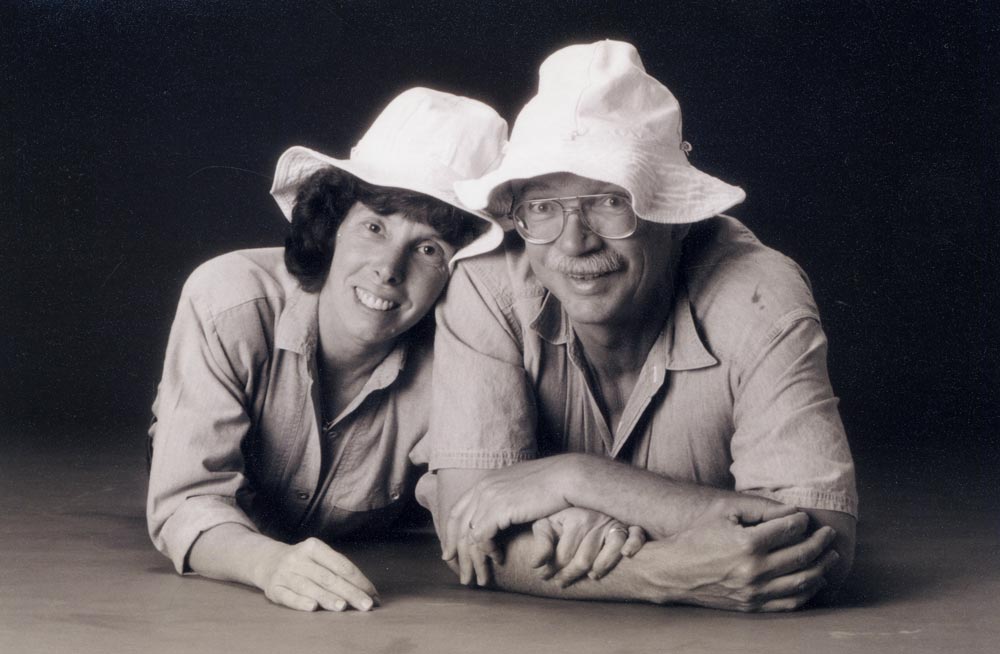
Larry Buchanan earned his PhD in Economic Geology in 1979 and taught university-level geology for several years, but his love of the field led him to gold and silver prospecting in Asia, Africa, and the Americas. In 2006, he won the coveted Thayer Lindsley Award for the San Cristobal silver discovery. Dr. Buchanan has published a dozen scientific works and is a sought-after speaker at international conferences and college campuses.
Karen Gans earned her Master’s degree in Early Childhood Development and has thirty-five years experience as an educator, counselor, and mental health consultant. She taught English in the Quechua village while the couple lived in Bolivia. Ms. Gans and her husband have four children and two grandchildren.
To find out more visit http://thegiftofeltio.com.
Where did you grow up?
Larry – I was born and raised in the Pennsylvania coal fields, but at 11 moved to the Mojave Desert of California where I fell in love with the wide open spaces. Each weekend I hiked up and down the canyons and ridges, crawled through abandoned mines, and searched for veins of silver and gold. I read geology books before I was in high school, so you might say I was a prospector since my pre-adolescence.
Karen – I grew up in Connecticut, surrounded by trees and no desert in sight. That made living in the high desert of Bolivia a challenge!
When did you begin writing?
Larry – I began writing in 1964, my sophomore year of college. My professors said my imagery was like that of Saroyan, whom I had never even heard of but I assumed it was a compliment. Then for about 30 years I was too busy making a living to give creative writing much thought.
Karen – I wrote professional reports from the time I was in my twenties.
The Gift of El Tio is my first creative non-fiction endeavor. Larry and I began to document events in 1998 and it took twelve years to write our book.
Do you write during the day, at night or whenever you can sneak a few moments?
Larry – I write best from 5 AM to 11 AM, then the day's crises take over.
Karen – I like to write in the mornings, read what I’ve written later in the day, and revise the next morning.
What is this book about?
Larry – Initially, we planned to merely document the changes in the people as my company destroyed their village. At the time, I felt that everything could be reduced to a mathematical common denominator, that cold, hard facts trumped culture, feelings, history and religion every time; and that the impoverished 17th Century village had nothing worth preserving. The silver discovery was mine, by God, they were going to move, and nothing more needed be said. Imagine my surprise when not only did I become intrigued with the color and value of Quechua culture and cosmology, but I also learned that the silver discovery wasn’t mine at all: The people knew the silver was there all along, they were just waiting for the fulfillment of a 400-year old prophesy from their god, El Tio, who promised them a gift that would change their lives forever, a gift to be revealed in the year 2000. It seems I was just a convenient messenger for this god to help fulfill his promise. Indeed, El Tio’s silver gift did change their lives forever, but he never said the changes would be for the better, and like most gifts, this one had many strings attached.
Karen- Although we set out to document the changes in the village, the book also became the story of the changes in each of us. As I describe in your next question below, Larry and I came from polarized viewpoints regarding development in third-world countries. We wrote
The Gift of El Tio in alternating chapters, first my voice, then Larry’s. People tell us it reads like a suspenseful novel.
What inspired you to write it?
Karen – I was appalled when Larry told me his company would have to move an indigenous village in order to build a mine. I am quite liberal; Larry, conservative. I argued that it was immoral to destroy a culture; he, that the mine would bring jobs and eradicate poverty and that culture did not feed hungry people. I felt so strongly that I demanded we live in the village and document the changes.
Larry - Karen made me do it. Women have a way of controlling men.
Who is your favorite character from the book?
Larry – Without a doubt it is that old sprite, Juan de la Cruz Copa Quispe, the chief of the village whose perpetual smile was only broken by a grin. Don Juan was the keeper of the customs and he was eager to teach us the myths, prophesies and rituals of his people.
Karen – My favorite character is based on the adolescent, Soledad, who befriended me early on. She could understand my faltering Spanish and would interpret what was going on around me. This young lady was so resourceful – she maneuvered the rocky terrain like a goat, could hunt and catch the desert critters, and she dreamed of becoming a mechanic/chauffeur.
Was the road to publication smooth sailing or a bumpy ride?
Karen- After numerous “almosts” followed by rejections from agents, we were fortunate that our writing instructor, Molly Tinsley, and her colleague, Karetta Hubbard, created FUZE publishers and wanted our book. Molly not only helped us get published, but she also did an excellent job of editing our manuscript.
If you knew then, what you know now, is there anything you would have done differently?
Larry – Yes, I would have made the book twice as thick. We have so many fascinating stories we didn't put in. Of course, the conventional wisdom is that thick books don't sell.
Karen – I can’t think of anything. Larry and I had great fun – for the most part – writing together. I do feel sad that we had to omit some of the chapters.
Where can readers purchase a copy of your book?
From:
Fuzepublishing.com
Amazon.com,
Kindle and Nook
Do you have a video trailer to promote your book? If yes, where can readers find it?
Yes, the trailer can be found on our website:
thegiftofeltio.com (media and press –radio,television,video), Fuzepublishing.com or
Youtube
What is the best investment you have made in promoting your book?
Larry - Getting to know our editor Molly Best Tinsley and our publisher Karetta Hubbard. Fuze Publishing also puts out an excellent newsletter thanks to Meg Tinsley.
Karen – Larry contacted 3,000 geologists, letting them know this book is available. I thought Larry might lose his professional credibility. (You’ll see why when you read the book). However, the book is being used to sensitize geologists to how they impact cultures. It does help that Larry is a world-renowned geologist. Also, selling electronic books is profitable.
What is one piece of advice you would like to share with aspiring authors everywhere?
Larry – Live first, then write.
Karen – keep writing
What is up next for you?
Larry – An autobiography in which I not only tell you how to discover huge silver deposits, but also give you clues that tell you exactly where one is waiting to be discovered.
Karen – I’ve witnessed the struggles of an illegal immigrant family and I’m hoping to tell their story.
Is there anything you would like to add?
Larry - There is nothing like huddling around a fire in the cold nights while the wind whistles through the grasses and sage, listening to the stories told by the shaman and chief of the village, watching their faces as the wind screams…is that a man?…a spirit? …maybe El Tio is hungry tonight? Wrap the llama fur about you and stay close to the fire.
Price: $19.95 paperback,
$5.99 ebook
Pages: 254
ISBN: 9781450739146
Publisher: Fuze Publishing
Release: December 2010
Amazon paperback buy link:
http://www.amazon.com/dp/1450739148?tag=tributebooks-20
Fuze Publishing paperback buy link:
http://fuzepublishing.com/books?fpcat=non-fiction-book
Amazon Kindle buy link:
http://www.amazon.com/dp/B004CRTGCK?tag=tributebooks-20
Barnes&Noble.com Nook buy link:
http://click.linksynergy.com/fs-bin/click?id=dcSBhG3Rj8w&offerid=239662.2940012708496&type=2&subid=0
The Gift of El Tio's web site:
http://thegiftofeltio.com/
The Gift of El Tio's blog:
http://thegiftofeltio.com/authors-blog/
The Gift of El Tio's Facebook:
https://www.facebook.com/pages/The-Gift-of-El-Tio/227041177311458
The Gift of El Tio's Twitter:
https://twitter.com/thegiftofeltio
The Gift of El Tio's Goodreads page:
http://www.goodreads.com/book/show/10216123-the-gift-of-el-tio
Fuze Publishing's Facebook:
https://www.facebook.com/pages/Fuze-Publishing-LLC/297440248596
Fuze Publishing's Twitter:
https://twitter.com/#!/fuzepublishing
Fuze Publishing's Website:
http://www.fuzepublishing.com/
Fuze Publishing's Blog:
http://fuzepublishing.wordpress.com/
The Gift of El Tio's Blog Tour Site:
http://thegiftofeltio.blogspot.com/
Tribute Books Blog Tours Facebook:
https://www.facebook.com/pages/Tribute-Books-Blog-Tours/242431245775186






 Posts
Posts