Showing posts with label historical novel. Show all posts

Monday, March 4, 2019

Interview with Planaria Price, Author of Claiming My Place

Planaria Price went to public schools when the San Fernando Valley of Southern California was still a rural suburb. She had a fairly sheltered happy childhood. After graduating from Berkeley and earning a master’s degree in English Literature from UCLA, she followed her passion and started teaching English to adult immigrants in the public schools of Los Angeles. While teaching for forty years, she wrote several ESL books about American culture, folktales and myths and has lectured at more than a hundred conferences and schools. In addition to this, she has worked with her husband to save and restore over thirty Victorian and Craftsman homes in a historic Los Angeles neighborhood. Claiming My Place is her first book for young adults. Her website is www.planariaprice.com and her Instagram is @planariaprice. She is on Facebook as Planaria Price.

Where did you grow up?

I grew up in the San Fernando Valley of Southern California.

When did you begin writing?

I had always been an avid reader. I clearly remember a day when I was eleven. I suddenly threw down the book I was reading and decided I was going to write a book, too. I got out a blank notebook and started writing.... maybe a sentence or two. Then realized, to my utter surprise and sadness, that I had no clue what to write about; I had no plot. I had only an imagination that went nowhere. Throughout school, especially middle and high school, I excelled in English and often won prizes for my imaginative writing. But, alas, all my school papers were imaginative re-tellings of the lives of famous historical characters. I have now accepted the fact that I am solely a nonfiction writer and of my seven published books all are nonfiction. But hooray! I now have a genre classification: creative nonfiction.

Do you write during the day, at night or whenever you can sneak a few moments?

Alas, my writing has landed at the bottom of the to-do pile.   Life keeps getting in the way. When I am able to grab unbroken spaces of time, I write………. whenever I can “sneak” in a few moments”.

What is this book about?

Claiming My Place is a unique Holocaust biography because my subject, Barbara Reichmann, had such an incredibly vivid memory from the time she was three. Therefore, the book is not just about that horrible time when the Nazis took over Poland in 1939. I was able to write a book that encompasses her whole life. It is the full picture of what normal middle-class Jewish life was like in Poland in the 1920’s and 1930’s. Barbara is an extraordinarily smart and feisty child, a thinker, a doer. The book details her life from kindergarten, describes Jewish traditions, normal family life, her teen age years with her friends and boyfriend Heniek, as well as her university life. When the war comes, it details what happened to the Poles and the Jews as the Nazis arrived, the labor camps, ghettos, the deportations. Barbara was able to escape just before the deportations……. she had false papers and was able to “pass” as a Polish gentile. The book then details her life in hiding, getting a job in Germany as a “Polish” worker, the liberation in 1944 and her life in America as a refugee. It runs the whole gamut so that the reader gets a chance to meet a fascinating person and at the same time the reader learns about that time in history. Reviewers say that the book is unique, a riveting and fast read that seems like fiction but is 100% true.


What inspired you to write it?

As I describe in the preface, it was truly a dark and stormy night in April 2005. My husband and I were eating dinner at the bar at Nepenthe in Big Sur, California. For some reason, (neither Helen nor I remember why) the woman sitting next to me, Helen West, turned to me and started telling her mother’s Holocaust story. It was so incredibly unique and fascinating, I urged her to write it down. She said she was a psychotherapist and not a writer. My husband said “Planaria’s a writer” and I gave her my card. She evidently googled me and a few months later emailed “Let’s do it”. In October 2005, I flew to Washington DC, stayed with Helen for a week and interviewed ninety-year-old Barbara Reichmann for five days. She was such a delightful vibrant woman with the clearest of memories that went back to when she was three. The collaboration process was that I would be the writer and Helen would be sure that everything included in the book was 100% accurate. Wanting Helen to be a major part of the process, I ended my part when Barbara got to America and asked Helen to write the afterward about her memories of their life in the USA from 1951 until the death of Barbara in 2007.

The fact that Barbara’s memory of her childhood was so fascinating and vivid made me realize that I had the makings of a totally unique book about the Holocaust. No other Holocaust book that I have read follows the protagonist from peacetime early childhood to the onslaught of the Nazis and describes the refugee experience as well. I realized I had a wonderful medium to show readers what normal middle class Polish Jewish life was like in the 1920’s-1930’s. I knew it would be a marvelous educational possibility as well as emotional—to portray the tragedy of what has been lost.

Was the road to publication smooth sailing or a bumpy ride?

I started writing the book in 2005. I finished the first draft within 3 months and spent 2006 re-writing and re-writing. From the beginning I wanted a real publisher so that this story would get out, especially to schools and libraries. I am hopeless and helpless at self-marketing, so not interested in self-publishing. I had sent a chapter of the book to about 50 literary magazines and it was published in two. From 2007 to 2015 I queried 87 agents and of the few who actually wrote back, they were rejections. I attended writing conferences and joined the SCBWI.

I was not going to give up, but it was so depressing and hard. Finally. In 2015, query #88 to the Deborah Harris Agency got a nod. Within a few months’ time it had been sold to Farrar Straus Giroux. The editing process took about two years, but since I have six other published books, I expected the frustrations of that process.

Editors will remove your favorite words, sentences, topics. You will fight back, sometimes you will win. After our back and forth, I was able to have them put back a lot of my favorite parts. They were absolutely right when they took out my excessive adverbs and excessive melodrama. In truth, the editing process with FSG was lovely and they helped with quite a lot of research and finding photos. They edited it with a fine tooth comb, for sure.

If you knew then, what you know now, is there anything you would have done differently?

Actually, no. I learned there is a hard world in publishing out there and finding the right agent is an often-insurmountable task. I can’t think of anything I could have done to have made the process go easier or faster. Maybe I should have eaten more dark chocolate.

Where can readers purchase a copy of your book?

The book is available on Amazon, and Barnes and Noble and at a lot of Independent book sellers.

It’s also available on Macmillan’s website.

What is one piece of advice you would like to share with aspiring authors everywhere?
Don’t quit your day job, but never give up

What is up next for you?

I’m currently working on a YA travel memoir called Before McDonald’s Ate Europe. I feel quite hopeful about this one because I think my 88th agent will love it.


Is there anything you would like to add?

Just thanking you for considering Claiming My Place.

Monday, January 28, 2019

Book Review: The Perilous Adventures of the Cowboy King by Jerome Charyn

Just when you think Jerome Charyn has crafted the best book he could ever write, he comes out with a new one that is even better than the last.

The Perilous Adventures of the Cowboy King is a novel of Teddy Roosevelt, who would one day become the 26th president of the United States. Covering the years of 1862 when he was still suffering from debilitating asthma, through 1901 when Vice President Theodore Roosevelt is on his way to take a new oath after President McKinley is assassinated, the reader discovers the whirlwind that was Roosevelt.

Charyn makes this larger than life historical figure even grander through his well-researched, in-depth account of the man's tragedies and triumphs. Told in first person, every detail and each rich description draws the reader into Roosevelt's world. Lovers of historical novels will be captivated by this Cowboy King who pushed himself outside of his comfort zone every day of his life. The story is as unique as he was.

With The Perilous Adventures of the Cowboy King, Charyn has outdone himself. Another amazing historical figure that he brings to life in colorful new ways. A phenomenal story. A clever cover. No wonder Charyn has been entertaining readers for decades. He's the best at what he does, and he leaves readers longing for more.


Hardcover: 304 pages
Publisher: Liveright (January 8, 2019)
Language: English
ISBN-10: 1631493876
ISBN-13: 978-1631493874

I received a copy of this book from the author's publicist. This review contains my honest opinions, which I have not been compensated for in any way.

Tuesday, January 22, 2019

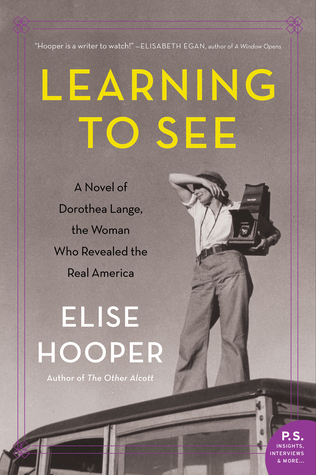
New Release: Learning to See by Elise Hooper


At a time when women were supposed to keep the home fires burning, Dorothea Lange, creator of the most iconic photographs of the 20th century, dares to be different. Now, in this riveting new novel by the author of The Other Alcott, we see the world through her eyes…


In 1918, a fearless twenty-two-year old arrives in bohemian San Francisco from the Northeast, determined to make her own way as an independent woman. Renaming herself Dorothea Lange she is soon the celebrated owner of the city’s most prestigious and stylish portrait studio and wife of the talented but volatile painter, Maynard Dixon.

By the early 1930s, as America’s economy collapses, her marriage founders and Dorothea must find ways to support her two young sons single-handedly. Determined to expose the horrific conditions of the nation’s poor, she takes to the road with her camera, creating images that inspire, reform, and define the era. And when the United States enters World War II, Dorothea chooses to confront another injustice—the incarceration of thousands of innocent Japanese Americans.

Learning to See is a gripping account of the ambitious woman behind the camera who risked everything for art, activism, and love. But her choices came at a steep price…

Paperback: 384 pages
Publisher: William Morrow Paperbacks (January 22, 2019)
Language: English
ISBN-10: 0062686534
ISBN-13: 978-0062686534


Purchase here!

Saturday, September 17, 2016

New Release: Monticello: A Novel of A Daughter and Her Father by Sally Cabot Gunning


From the critically acclaimed author of The Widow's War comes a captivating work of literary historical fiction, set in America in the years after the Revolution, that explores the tenuous relationship between the brilliant and complex founding father Thomas Jefferson and his devoted daughter, Martha Jefferson Randolph.

After the early death of her mother, young Martha Jefferson accompanied her father, Thomas Jefferson, on his first diplomatic mission to Paris. Five years later, father and daughter have come home to Monticello, the family’s beloved plantation set high in the lush hills of the Virginia countryside.

Though Monticello has suffered from her father’s absence, Martha finds it essentially unchanged, even as she has been transformed. The sheltered girl that sailed to Europe is now a handsome seventeen-year-old woman with a battle-scarred heart, who sees a world far more complicated than it once seemed.

Blessed with her father’s sharp mind and independent spirit, Martha has long abhorred slavery and yearned for its swift end. Yet she now discovers that the home she adores is burdened by growing debt and cannot survive long without the labor of its slaves. Her bonds with those around her are shifting, too. As the doting father she has idolized since childhood returns to government, he becomes increasingly distracted by tumultuous fights for power and troubling attachments that pull him further away. And as Martha begins to pay closer attention to Sally Hemings—the beautiful light-skinned slave long acknowledged to be her mother’s half-sister—she realizes that the slave’s position in the household has subtly changed. Eager for distraction, Martha welcomes the attentions of Thomas Randolph, her exotic distant cousin, but soon Martha uncovers burdens and desires in him that threaten to compromise her own.

As her life becomes constrained by the demands of marriage, motherhood, politics, scandal, and her family’s increasing impoverishment, Martha yearns to find her way back to her childhood home; to the gentle beauty and quiet happiness of the world she once knew at the top of her father’s “little mountain.”

An irresistible blend of emotional drama, historical detail, and vivid atmosphere, Monticello skillfully brings to life Martha Jefferson Randolph, a strong and compelling woman who influenced -- as much as she was influenced by -- one of the most intriguing figures in American history.

Hardcover: 368 pages
Publisher: William Morrow (September 6, 2016)
Language: English
ISBN-10: 0062320432
ISBN-13: 978-0062320438

Purchase at:

HarperCollins
Amazon
B&N
Books-A-Million
Indiebound

Wednesday, September 11, 2013

Book Review: The Queen's Vow by C. W. Gortner

Filled with political conflict, religious tensions, intrigue, and romance, The Queen's Vow by C. W. Gortner portrays the early life of the woman known to history as Isabella of Castile.

Barely a teenager, Isabella and her brother, Alfonoso, are taken from their mother's home to live under the watchful eye of their half-brother, King Enrique, and his conniving queen. When Isabella becomes a pawn in a plot to dethrone Enrique, she is suspected of treason and held captive. At the age of seventeen, she finds herself heiress of Castile and is plunged into a deadly conflict to secure her crown, while determined to wed the man she loves, Fernando, prince of Aragón.

Isabella and Fernando face difficult times: an impoverished Spain beset by enemies, the demands of the inquisitor Torquemada to punish relapsed conversos, and a declaration of war from the Moors. Isabella's resolve and courage are put to the test as she moves toward fulfilling her God-given destiny.

The Queen's Vow is such a superb book, I'm sorry I didn't read it sooner. I'm even more upset that it's finished, because I want to experience it all over again. Rich descriptions, stunning settings, and a fascinating plot filled with a host of historical figures spring to life through Gortner's masterful hand. While a bit of a slow starter for me, once the puzzle pieces were in place for Isabella to inherit the throne, I became totally engrossed. From the fights to secure her crown to wedding the man of her choosing at a time when women were not given the power to do so, Isabella proved a force to be reckoned with. Her deep faith and willingness to put herself in harm's way led to much admiration.

Reading The Queen's Vow also helped me to have a greater understanding of the origins of Gortner's earlier book, The Last Queen, which is about Isabella and Fernando's daughter, Juana, the last queen of Spanish blood to inherit her country's throne.

What I was pleased to see with The Queen's Vow is that Gortner ends it at a what I would say a perfect place. After years of war and division, Isabella can look toward the future.

Highly recommended!


Paperback: 416 pages
Publisher: Ballantine Books; Reprint edition (July 2, 2013)
Language: English
ISBN-10: 0345523970
ISBN-13: 978-0345523976

I received a free hardcover version of this book from the author. This review contains my honest opinions, which I have not been compensated for in any way.

This is the 11th book I've read for the following challenge:


Tuesday, July 31, 2012

Book Review: Annabel's Story by Mary Jean Kelso

Mabel leaves the streets of New York when she is placed on an Orphan Train bound for the West. Separated from the one friend who journeyed with her, she arrives in New Mexico and is adopted by the Westerman family. She changes her name to Annabel and begins to learn more about herself, her new family, and her new home.

Unaware of the secret she carries, Annabel hopes she can find love and happiness on the homestead. But her secret could pull her back to streets.

Young Toby Meltonberger makes his living on the streets of New York as a newspaper boy. Hardworking and honest, he dreams of a better future. He doesn't know where Mabel has gone. He only knows he has to find her.

In this moving historical, author Mary Jean Kelso has created a story of a young woman searching for her place in the world. Torn away from the only life she's known, Annabel has no idea what the future brings. She can only hope it is better than the past.

Kelso has woven so many wonderful elements into this story: details of the American frontier, well developed characters, an engaging plot, sweet romance, and a young woman's desire to find the kind of life she isn't sure she will ever have. While this is definitely Annabel's story, Toby's motivation to find her plays an integral role.

Annabel's Story touches the heart. The fifth book of Kelso's Homesteader series, this historical  will be enjoyed by those who enjoy sweet romances and books set on the American frontier.


  • Paperback: 262 pages
  • Publisher: Wing ePress (2012)
  • Language: English
  • ISBN-10: 1613099231
  • ISBN-13: 978-1613099230
  • SRP: $16.95
  • Ebook: $7.50

  • I received a free electronic version of this book from the author in exchange for my honest opinion. I received no monetary compensation of any kind for this review.

    This is the 36th book I've read for the following challenge:


    This is the 22nd book I've read for the following challenge:


    Friday, February 10, 2012

    Interview with Kathy Holmes, Author of Letters on Balboa Island

    Born in the City of Angels, raised on Walt Disney, and inspired by the dreams of both, Kathy Holmes grew up in southern California halfway between Disneyland and the beach.


    Tantalized by the tropics since Adam Troy set sail on the Kon Tiki in James A. Michener’s “Adventures in Paradise,” she traveled to tropical destinations such as Hawaii, Florida, the Caribbean, Mexico, and Asia Pacific. Eventually, she moved to Florida where she wrote and secured representation for Real Women Wear Red. She also wrote for Walt Disney World and the Orlando Sentinel.

    After living in Las Vegas for a few years, Kathy, her husband, and their three Burmese cats have moved back to Florida and are now living halfway between Walt Disney World and the beach in Central Florida. Her latest book is Letters on Balboa Island.

    Can you tell us a bit about yourself?

    I grew up halfway between Disneyland and the beach and I have such fond memories of that place and that time. I draw on some of those experiences in Letters on Balboa Island because my family went there often – either to swim in the ocean or the Bay, ride the Ferris Wheel, eat a frozen banana, or peek into the fancy houses just before dusk when people turned on their lights and left the windows open. My step-dad was slightly embarrassed when my mother and I let out an occasional ooh and aah. I didn’t find out until recently that she used to go to Balboa Island with her friends when she was a teen.

    When did you begin writing?

    I was living/working in a high-stress job in Silicon Valley, had recently married my soulmate, and longing to switch careers. I started thinking about my love of fiction and how I’d promised myself that one day I would write a novel. Sound familiar? Anyway, with my new husband’s whole-hearted encouragement, on January 31, 2002, I ordered the “Immediate Fiction” workshop course from the Writer’s Loft in Chicago. I discovered later that this was the same workshop that my favorite author Laura Caldwell participated in.

    What is this book about?

    It’s about choices and second guessing those choices. It’s about one woman’s opportunity for redemption. It’s the “what if” many of us think about when looking over our life and recalling “the one who got away.” Here’s the short blurb:

    When Rosalie sends a Dear John letter to the one serving in the Korean War to marry the one back home, she begins a life of secrets and regrets. Years later, when letters surface on Balboa Island, she realizes she may have chosen the wrong man. So when fate gives her the chance to make a different choice, will she? Or has she lived a life of lies for too long?

    What inspired you to write it?

    I think I’ve always been fascinated by “the one who got away” as my mother used to say. By the excitement in her voice, I think it intrigued her, too. We sometimes read stories in the paper about high school sweethearts who married other people but then reunited later in life. These stories intrigue me. But what about when the person returns from the past and you choose not to make a different choice? Because life isn’t that simple—there are complications that make the choice difficult, especially when there are consequences. So when presented with an opportunity to make a different choice, would you really? That idea stuck with me and so I wrote “Letters on Balboa Island.”

    Where can readers purchase a copy of your book?

    All of my books are found on amazon.com or you can find the link from my web site and/or blog.

    Do you have a website and/or blog where readers can find out more?
    My web site is http://www.kathyholmes.net/ with a link to my blog at http://flipflopsandfabs.blogspot.com/.

    What is up next for you?

    I have a completed manuscript that’s ready for revisions. It’s a little different from what I’ve done before, but then, all of my books are different from one another. REAL WOMEN WEAR RED is considered chick lit/hen lit, THE TOM JONES CLUB is a romance, LETTERS ON BALBOA ISLAND is a nontraditional historical, and my next manuscript is more of a psychological thriller.

    Thursday, August 18, 2011

    Interview with Dr. Jeri Fink, Author of Trees Cry for Rain

    Joining us today is Dr. Jeri Fink, author of the historical novel, Trees Cry For Rain.

    Jeri is an author, traveler and Family Therapist with over nineteen books and hundreds of articles to her name. She writes adult and children’s fiction and nonfiction. She has appeared on television, radio, book events, seminars, workshops and the Internet. Dr. Fink’s work has been praised by community leaders, educators, reviewers and critics around the country.

    Welcome to The Book Connection, Jeri. It's lovely to have you here. Can you tell us where you grew up?


    Bayside, Queens - in the shadow of Manhattan. I was taking city buses and subways when most kids my age were riding bikes and playing with dolls. City life was always an adventure, even in the "outer" boroughs. I walked to school, which always seemed like an endless trek for a little kid. I passed people in the street and made up stories about them. My favorite stories often involved Alex, the ice cream man. All the kids loved him. But in my head, Alex was plunging into dark, evil city parks, rescuing wild stallions with fiery eyes, and finding passionate love on the 7 train. I bought ice cream every day!

    When did you begin writing?

    I was eight years old and it was very late - long past my bedtime. Instead of sleeping, I aimed a flashlight on my notebook so I could write a new story. The black-and-white composition book was bursting with stories about people I knew and didn't know, strangers I saw on buses and subways, and characters I conjured up in my imagination. Behind me, there was a stack of notebooks. I filled every page with a story.

    Then it hit me.

    I was put on this planet to write.

    I've done a lot of things since that moment. But I always knew what I was meant to do. That has never changed. I'm here to write. And that is something I will never forget.

    Do you write during the day, at night or whenever you can sneak a few moments?

    I always write. Writing extends far beyond my keyboard and pen-and-paper. I'm constantly thinking, constructing new scenarios, visiting strange characters and being bombarded with ideas. My best (most energetic) writing is usually in the morning, from the time I get up until lunch - about five hours. The rest of the day is spent rewriting and editing. I'm one of those strange authors who actually ENJOYS rewrites and edits - it feels like I'm a painter using oils on a canvas. It takes more time for that process than writing the original manuscript! Frequently, in the late evening after 9 PM, I get a second wind and return for several hours to work on the original. If I hit any problems, I put the questions in my head right before I go to sleep. I wake up in the morning with the answers.

    I'm writing this interview at 11 P.M.

    What is this book about?

    Trees Cry For Rain is a gripping historical novel that tells the story of courageous individuals who fought to survive the lethal forces of their times. The novel begins with one woman who gives her life to protect her three young daughters. Five hundred years later, this past ruthlessly crashes into the present where the ghosts of yesterday confront the newest generation.

    What inspired you to write it?

    Years ago, I read about a group of people in New Mexico who followed traditional Jewish customs although they were Catholic - lighting candles on Friday night, refusing to eat pork and playing Christmas games with a four-sided spinning top. Local historians traced their ancestry back to Secret Jews who had fled the Spanish Inquisition. I was haunted by their experiences. What was it like to live a double life - going to church with your neighbors while secretly practicing Judaism - a crime punishable by death? How did it feel to risk everything for religious beliefs? What happens when people keep dangerous secrets - live schizoid existences that span generations? Lastly, what would they look like today? It took me four years of research, travel, interviews and writing to answer those questions.

    I chose New York City as the point of convergence - where the past crashes into the present. As a native New Yorker, I have always loved the mystery, challenge and contradictions of the city. It was a natural environment for my characters to find closure.

    Are you a member of a critique group? If no, who provides feedback on your work?

    I edit every word, idea and concept multiple times. When I can't find any more errors, I send my completed manuscript to at least six readers - the last one is a professional editor - then rewrite again, based on their comments. I have lengthy discussions with and about my characters and check each historical fact in many different sources. When I can't correct another word, I know the manuscript is ready. Happily, Casey Swanson, my publisher, has validated my obsessive attention to detail. He said that the book hardly needed editing. That's one of my favorite compliments!

    Who is your favorite author?

    There are so many good books and authors that I want to read everything and everyone. Although I prefer some genres, like historical fiction and psychological thrillers, I try anything. Some of my favorite modern classics are by Steinbeck, Hemingway, Faulkner, Uris and Michener. Mark Twain was one of my earliest muses. As a teenager, I cried with Anne Frank and Pearl S. Buck, and read every word Kurt Vonnegut and Tolkien wrote. I'm a devoted J.K. Rowling fan! These days, I make sure to read books written by some of my favorite contemporary authors like Greg Iles, Naomi Regan, Jodi Picault, Harlan Coben, Nelson DeMille . . . the list goes on as long as authors are writing good books! My favorite journalist is Marge Mendel. Her work is awesome!

    Do you have an agent or are you looking for one?

    I have had several agents over the years - and none of them ever sold a book for me! At one point, I had an agent with a fancy Manhattan address and a publicist - but no luck. Trees Cry For Rain was sold to my publisher (Dailey Swan) after I met them at BEA (Book Expo America) in New York. My first Trees book signing took place, pre-publication, at BEA!

    Was the road to publication smooth sailing or a bumpy ride?

    Is any road to publication smooth? I experienced the best (and worst) in the industry. My first professional job was a copywriter for Prentice-Hall. From there I went to Bantam Books, and eventually into free-lance journalism. The rigid requirements of copywriting helped enormously in developing the "craft" of writing. Since then, I've experienced everything from the joy of publishing fiction and nonfiction to the anger of having my work stolen and published under an in-house editor's name who had reviewed it for publication (No - I never filed a lawsuit. I didn't want to risk getting a bad reputation in the industry). I've met editors who are like the legendary Max Perkins (the man who edited Hemingway, Fitzgerald, and Wolfe) and kids out of college who need a course in grammar. I've come up against unscrupulous book doctors (people who charge money to edit an individual book) and haughty, competitive authors. I haven't had a New York Times bestseller yet, but who knows?

    If you knew then, what you know now, is there anything you would have done differently?

    I would make my first book a bestseller! Of course, that wasn't in the cards :-)

    Where can readers purchase a copy of your book?

    Trees Cry For Rain can be purchased at most online book retailers, like amazon.com, barnesandnoble.com and booksamillion.com. For those who like to support their local independent bookstores, go to indiebound.org Some local brick-and-mortar stores carry copies; if they don't, most will put in a special order to the major distributors that carry my book.

    Do you have a website and/or blog where readers can find out more?

    Yes. Please visit me at my website - http://www.drjerifink.com/ - or feel free to email me at drjeri@drjerifink.com I'm all over the Internet - from Face Book and Scribd.com to Author's Den.

    For those who want to have fun, check out my "Trees Travel" site, where readers send in photos of the book with family, friends, pets and colleagues from all over the world. You might find out why Wyatt Earp was late for the gunfight at O.K. Corral!

    Go to: http://www.drjerifink.com/Trees_Travel_Photos.html

    Do you have a video trailer to promote your book? If yes, where can readers find it?

    My video trailer is at: http://www.youtube.com/watch?v=wGCrcixXsek

    My video where I read from the book is at: http://www.youtube.com/watch?v=9gzTRy6BlSs

    What is the best investment you have made in promoting your book?

    Time - and the virtual book tour with Pump Up Your Book.

    What is up next for you?

    I completed my next novel during the two years it took for Trees to be published. It's now on my publisher's desk. The working title is Jakob: A Perfect Psychological Storm. It's a different genre - a psychological thriller. I'm presently working on another historical novel, similar to Trees Cry For Rain, that begins in 17th century Manhattan.

    Is there anything you would like to add?

    Never stop reading, writing, learning, thinking and doing. It's all part of the final book. If you worry about writer's block, you'll get it. Each pause in the narration leaves time to reflect, review what has happened and visualize where it's headed. Writing is passion, craft and hard work. You have to really love it to create that special book.

    Thank you for spending time with us today, Jeri. We wish you continued success.

    Thursday, March 3, 2011

    Author Interview: John Milton Langdon, Author of Against All Odds

    John Milton Langdon is a Fellow of the Institution of Civil Engineers and has a master’s degree in maritime civil engineering. Langdon retired and became a professional writer after an active and rewarding engineering career. Langdon lives in the Austrian town of Klagenfurt, which has a history stretching back to mediaeval times. Langdon has three children and five grandchildren from his first marriage and two step-sons from the second.

     
    John’s latest book is an historical novel titled Against All Odds: Jason Smiley Stewart-My Life Story. We'll talk to him about his childhood, his writing, and what the future holds.

    Welcome to The Book Connection, John. It's great to have you here. Can you tell us a bit about yourself?

    I am a Fellow of the Institution of Civil Engineers in London and I have a master's degree in maritime civil engineering. I was born in Britain and initially worked there but from 1972 until 2006, I was involved with project development in Bahrain, Iran, Iraq, Saudi Arabia, the United Arab Emirates and Nigeria. After an active and rewarding engineering career, I retired and became a professional writer. I have many interests including travel, the British canals, music and literature but hiking in the foothills of the Alps near my home is a preferred activity.

    Where did you grow up?

    I was born and grew up in Britain in the small coastal town of Barry in South Wales during the second world war.

    What is your fondest childhood memory?

    As a very small boy I remember sitting on a carpet in front of the living room fire on a cold winter evening and hearing the wind rampaging around the house. My father, mother, elder brother and my elder and younger sisters were also there in front of the fire. On the hearth was a big plate of sliced bread, a pot of home made beef drippen and the salt celler. We took turns to put a slice of bread on the toasting fork and when the bread was nice and brown we spread a layer of drippen on it, sprinkled it with salt and ate it with great delight. The taste was outstanding but in retrospect it was probably very unhealthy.

    When did you begin writing?

    I started writing shortly before I retired and effectively writing replaced engineering as my day job.

    Do you write during the day, at night or whenever you can sneak a few moments?

    Normally I write during the day and in the evening, but it isn't a totally exclusive activity.

    What is this book about?

    Based loosely on fact, Against All Odds describes the early years of a young man born into humble circumstances during the reign of Queen Victoria. He shows how a combination of intelligence and perserverance, aided by a little good fortune, can help any child overcome the disadvantages of poor education and lowly birth status in an era when status is all important. In Against All Odds, the first volume of a four-part series, you can read how Jason Smiley Stewart is transformed from callow village youth into a ship's officer.

    What inspired you to write it?

    In 2004 when I was working in Abu Dhabi, my wife and I visited a small Omani town called Khasab, which is located near to the Straits of Hormuz. One of the attractions there is an area known as the Fjords because of its similarity to Norwegian scenery. In English it is known as the Elphinston Inlet or transliterated from the Arabic, Khor As Sham. We sailed along Khor As Sham in an Arab dhow and anchored at Telegraph Island. I learnt from the dhow captain that a small team of British men had lived on the island during the 1850's in order to operate the repeater station on the newly constructed electric telegraph to India - this was at the very beginning of electronic communication. When I sat on that small, barren lump of rock in the heat of the midday sun, I could only marvel at the fortitude of men who could live and work under such appalling conditions. I believed there was a story to be written about the men and the island.

    Who is your biggest supporter?

    Until she lost a long battle with cancer, my wife.

    Are you a member of a critique group? If no, who provides feedback on your work?

    No, I haven't joined a critique group. Until she died my wife critiqued my writing and I was always amazed by her ability to provide cogent advice when her first language was German and not English.

    Who is your favorite author?

    There are many, but I think Nevil Shute would be top of the list.

    Do you have an agent or are you looking for one?

    I don't have an agent and have ceased looking for one.

    Was the road to publication smooth sailing or a bumpy ride?

    Before I discovered Tate Publishing it was an exceptioally frustrating experience, but afterwards everything worked as it should.

    If you knew then, what you know now, is there anything you would have done differently?

    Probably not.

    Where can readers purchase a copy of your book?


    Amazon: http://www.amazon.com/Against-All-Odds-Stewart-My-Stewart/dp/1598861476/ref=sr_1_2?ie=UTF8&s=books&qid=1293963559&sr=1-2

    Barnes & Noble http://search.barnesandnoble.com/Against-All-Odds/John-Milton-Langdon/e/9781598861471/?itm=1&USRI=john+milton+langdon

    Tate Publishing http://www.tatepublishing.com/bookstore/book.php?w=1-59886-14-7-6

    Do you have a website and/or blog where readers can find out more?

    Website is at http://www.jmlangdon.com/

    What is the best investment you have made in promoting your book?

    Hopefully this one, as my other efforts have not been very successful.

    What is one piece of advice you would like to share with aspiring authors everywhere?

    Don't give up!

    What is up next for you?

    I have a script for a BBC radio play competition to complete and I am trying to write another novel, but there are not enough hours in the day.

    Is there anything you would like to add?

    Against All Odds has been translated into German and I am currently looking for a publisher in either Austria or Germany.

    Thanks for spending time with us today, John. We wish you much success.

    Monday, November 8, 2010

    Guest Blogger: The Most Intimate Moments of Our Lives by Gabriel Constans, Author of Buddha’s Wife

    Today's special guest is Gabriel Constans, author of Buddha's Wife.

    Buddha’s Wife is a novel about compassion, inspiration and forgiveness. Thousands of books, texts and stories have followed Siddhartha’s teachings and his path to becoming The Buddha, but little has been written about his wife Yasodhara, their child Rahula or their relatives, until now.

    Yasodhara was the first woman in Siddhartha’s life, but not the last to follow in his footsteps. Why did he call his son “a hindrance” and believe women were a trap of desire and attachment “not fit to follow or understand my teachings”? How did Yasodhara and the nuns fight for equal treatment and rights? How could The Buddha have such compassion for others, yet be so scared of intimacy, emotion and love? What happened to sixteen-year-old Yasodhara and her two-day old son, Rahula, after her husband (Siddhartha) left her sleeping in the middle of the night to seek enlightenment?

    As Yasodhara lies close to death and shares her experiences as a young girl, a wife, a parent and then a nun, her son Rahula, who has been in self-imposed exile in Sri Lanka, attempts a perilous journey, with his wife and child, to reach his mother before she dies and release the secrets about his father that he’s kept buried inside. Will Rahula and Yasodhara’s dharma sister, reach Yasodhara in time to ask for forgiveness? Can anyone ever forgive the unforgivable?

    The Most Intimate Moments of Our Lives by Gabriel Constans


    Until I read bell hooks books on feminism and love -Communion: The female search for love and All About Love - I would have sworn that I supported women (and men’s) liberation in every aspect of my life. But after the first few chapters I became painfully aware of the fact that I haven’t applied the same understanding and equality I try to faithfully practice at work, with friends, raising children and doing household chores to my intimate romantic life.

    In Communion Ms. hooks says, “Some men cared enough to consent to feminist thinking and to change, but only a very, very few loved us - loved us all the way. And that meant respecting our sexual rights.”

    I always think of my partners pleasure and satisfaction during sex and am turned on by her joy as much or more than my own sensations, but I also saw how I used to use coercion, control, emotional distancing and blame to get what I wanted. I continually gave her the message (unconsciously and nonverbal) that she was never “good enough”. I always wanted her to be more sexual, more often with greater variety and be different than she was or is, in order to fulfill my desires, perceived needs and fantasies. The underlying implications were “if you don’t change or be more like I want you to be, I’ll have to leave and find someone else.” It created a sense of fear and rejection.

    Seeing this reality shattered my self-image of always being a loving, caring man and helped me acknowledge how often I and the continually reinforced messages from society, have caused such intense and long lasting loneliness for those women seeking loving, shared partnerships with men. Hooks states, “Feminist silence about love reflects a collective sorrow about our powerlessness to free all men from the hold patriarchy has on their minds and hearts. Our heartache came from facing the reality that if men were not willing to holistically embrace feminist revolution, then they would not be in an emotional place where they could offer us love.”

    I began to realize that it is love and connection that I desired most, not sex. I no longer need sex to reassure me that I am loved or wanted. In the past, having someone desire and want me sexually meant that they loved me. If they didn’t have sex as often as I wanted, I reacted out of fear and sadness believing it meant they didn’t love me completely. Out of this sadness I would react with frustration and anger by trying to get them to “prove” there love for me with sex or by emotionally distancing myself and not talking, in order to “protect” myself from having expectations or “being hurt”.

    These reactions and I believe that of most heterosexual men, are not realities I have totally ignored, but until reading hooks words I hadn’t really taken them to heart and honestly confronted my own patriarchal fears and thinking in the matter of love and relationships. It felt like bell had me in her sights when she said, “Feminist women stopped talking 
about love because we found that love was harder to get than power. Men, and patriarchal females, were more willing to give us jobs, power, or money than they were to give us love. Women who learn to love represent the greatest threat to the patriarchal status quo.”

    While reading Communion some kind of switch went on in my head. At first it opened the floodgates of grief over my part in perpetuating such profound alienation and pain. Then a kind of peace engulfed me – a newfound love and acceptance of my self and my partner. I am less stressed and anxious about the future and don’t try to make people be different than who they are. Is it any surprise that my partner has also experienced more peace with herself and in bed? She no longer has to worry or wonder if she will ever “be enough” or meet my suffocating patriarchal images of how she “should” be.

    As I learn to love, without depending on her to fulfill or “make” that love, she to is finding that our mutual appreciation and respect for what is present, rather than what is absent, has deepened every aspect of our lives. Neither of us need the other person’s “approval” to love or be loved.

    Ms. hooks insightfully reminds her readers that, “Knowing that both women and men are socialized to accept patriarchal thinking should make it clear to everyone that men are not the problem. The problem is patriarchy.” The problem is our refusal to acknowledge our own behavior in the most intimate moments of our lives and the fear of real connection and closeness that keeps us perpetuating the myths and lies about the minor differences of genes, gender and genetics.

    Gabriel Constans’ latest books include the novel, Buddha’s Wife, and a short story collection, Saint Catherine’s Baby. He has worked in East Africa at the ROP Center for Street Children in Rwanda, and has edited a collection of children’s stories, Rwandan Folk Tales.

    You can read more about the author and his work at http://www.gogabriel.com/ 

    Monday, September 20, 2010

    Lise Meitner: a physicist who never lost her humanity by Tom Weston, Author of Fission

    Today's special guest is Tom Weston, author of the historical fiction online series and upcoming novel, Fission.

    In a world that tries to deny her because she is a woman, tries to kill her because she is a Jew, Lise Meitner rises above it all to discover nuclear fission and spark the race for the atomic bomb.

    But, with the world now at her feet and a Nobel Prize almost in her grasp, her betrayal by the man she trusts the most may prove the hardest test of all.

    Lise Meitner: a physicist who never lost her humanity by Tom Weston

    So says the headstone at her grave in Bramley, England. It seems an odd, sleepy, backwater sort of place for her to be buried. She was born in a Vienna of imperial pomp and circumstance. She spent thirty years in Berlin. She moved with the rich and famous and powerful: President Truman, Eleanor Roosevelt, Albert Einstein and Max Planck, to name a few. She made the discovery that would hurl us into the nuclear age. For an all too brief moment, she was the most famous woman in the world. And yet, the rest (as Hamlet said) is silence.

    The inscription on the headstone was chosen by her nephew, Otto Robert Frisch. Along with her good friend, Niels Bohr, Frisch spent many years trying to wrong the rights that were done to Lise during her life, to get the world to recognize and honour her scientific achievements; and while she is still far from being a household name, it is thanks to them, and to the determination of biographers as Ruth Lewin Sime and Patricia Rife, that the world has not entirely heard the last of Lise Meinter.

    The clue as to why I picked up the story is to be found in the headstone. No, it isn’t the physics. For, as much as I like science, the scribbling of mathematical equations on blackboards and the clicking of Geiger-counters does not make for riveting story-telling. What drew me to the Lise Meitner story is the humanity.

    Imagine if you would a story of greed and betrayal, intrigue and danger, war and destruction, the slaughter of the innocents on a biblical scale and the collapse of empire. And imagine at the centre of it all one little woman, brilliant but shy, victimized but resolute, and ultimately vindicated. What a story that would make! Well, you don’t have to imagine it, because that is the Lise Meitner story. And I didn’t have to invent any of it – it’s all true.

    Lise shunned the spotlight; she would probably have disapproved of my version of her story, dismissed it as too gaudy, but I think her story is now much more important to the rest of us than it is to her. The world’s powers may have been content to let Lise rest in silence in the village of Bramley, but humanity is such a scarce resource that we cannot afford to lose any examples of it. If humanity is to flourish, Lise’s story and others like it need to be told, repeated often, and kept in our hearts and minds.

    My version of the Lise Meitner story is called fission. I feel so strongly that this story needs to be told and shared that I have made a serialized version of fission available on-line for people to read, free of charge. Obviously as a writer, I want my story to be read by as many people as possible, but more important is to get as many people as possible to know the name, Lise Meitner.

    Regards,

    Tom Weston


    Tom Weston’s work includes the fantasy based Alex and Jackie books, First Night and The Elf of Luxembourg. His latest project is fission, a novel based on the true life story of scientist, Lise Meitner. Prior to its scheduled paper publication in 2011, fission is being serialized online for Tom’s fans. To find out more about Tom and his work, or to read fission, please visit http://tom-weston.com/ or http://www.facebook.com/tom.weston.readers.

    Tuesday, September 7, 2010

    Author Spotlight: Juliet by Anne Fortier


    Juliet, an ambitious, utterly engaging historical novel on the scale of The Thirteenth Tale and The Birth of Venus, follows a young woman who discovers that her family’s origins reach all the way back to literature’s greatest star-crossed lovers.

    When Julie Jacobs inherits a key to a safety-deposit box in Siena, Italy, she is told it will lead her to an old family treasure. Soon she is launched on a winding and perilous journey into the history of her ancestor Giulietta, whose legendary love for a young man named Romeo rocked the foundations of medieval Siena. As Julie crosses paths with the descendants of the families involved in Shakespeare’s unforgettable blood feud, she begins to realize that the notorious curse—“A plague on both your houses!”—is still at work, and that she is the next target. It seems that the only one who can save Julie from her fate is Romeo—but where is he?

    Read an Excerpt!

    Alack, alack, what blood is this which stains The stony entrance of this sepulchre?

    It has taken me a while to figure out where to start. You could argue that my story began more than six hundred years ago, with a highway robbery in medieval Tuscany. Or, more recently, with a dance and a kiss at Castello Salimbeni, when my parents met for the first time. But I would never have come to know any of this without the event that changed my life overnight and forced me to travel to Italy in search of the past. That event was the death of my great-aunt Rose.

    It took Umberto three days to find me and tell me the sad news. Considering my virtuosity in the art of disappearing, I am amazed he succeeded at all. But then, Umberto always had an uncanny ability to read my mind and predict my movements, and besides, there were only so many Shakespeare summer camps in Virginia.

    How long he stood there, watching the theater performance from the back of the room, I do not know. I was backstage as always, too absorbed in the kids, their lines and props to notice anything else around me until the curtain fell. After the dress rehearsal that afternoon, someone had misplaced the vial of poison, and for lack of better, Romeo would have to commit suicide by eating Tic Tacs.

    "But they give me heartburn!" the boy had complained, with all the accusatory anxiety of a fourteen-year-old.

    "Excellent!" I had said, resisting a motherly urge to adjust the velvet hat on his head. "That’ll help you stay in character."

    Only when the lights came on afterwards, and the kids dragged me onstage to bombard me with gratitude, did I notice the familiar figure looming near the exit, contemplating me through the applause. Stern and statuesque in his dark suit and tie, Umberto stood out like a lone reed of civilization in a primordial swamp. He always had. For as long as I could remember, he had never worn a single piece of clothing that could be considered casual. Khaki shorts and golf shirts, to Umberto, were the garments of men who have no virtues left, not even shame.

    Later, when the onslaught of grateful parents subsided and I could finally walk off the stage, I was stopped briefly by the program director, who took me by the shoulders and shook me heartily—he knew me too well to attempt a hug. "Good job with the youngsters, Julie!" he gushed. "I can count on you again next summer, can’t I?"

    "Absolutely," I lied, walking on. "I’ll be around."

    Approaching Umberto at last, I looked in vain for that little happiness at the corner of his eyes that was usually there when he saw me again after some time away. But there was no smile, not even a trace, and I now understood why he had come. Stepping silently into his embrace, I wished I had the power to flip reality upside down like an hourglass, and that life was not a finite affair, but rather a perpetually recurring passage through a little hole in time. "Don’t cry, principessa," he said into my hair, "she wouldn’t have liked it. We can’t all live forever. She was eighty-two."

    "I know. But—" I stood back and wiped my eyes. "Was Janice there?"

    Umberto’s eyes narrowed as they always did when my twin sister was mentioned. "What do you think?" Only then, up close, did I see that he looked bruised and bitter, as if he had spent the last few nights drinking himself to sleep. But perhaps it had been a natural thing to do. Without Aunt Rose what would become of Umberto? For as long as I could remember, the two of them had been yoked together in a necessary partnership of money and muscle—she had played the withering belle, he the patient butler—and despite their differences, clearly neither of them had ever been willing to attempt life without the other.

    The Lincoln was parked discreetly over by the fire pit, and no one saw Umberto placing my old pack in the trunk before opening the back door for me with measured ceremony.

    "I want to sit in front. Please?"

    He shook his head in disapproval and opened the passenger door instead. "I knew it would all come apart."

    But it had never been Aunt Rose who insisted on the formality. Although Umberto was her employee, she had always treated him like family. The gesture, however, was never returned. Whenever Aunt Rose would invite Umberto to join us at the dinner table, he would merely look at her with bemused forbearance, as if it was an ongoing wonder to him why she kept asking and just somehow didn’t get it. He ate all his meals in the kitchen, always had, always would, and not even the name of sweet Jesus—spoken in rising exasperation—could persuade him to come and sit down with us, even at Thanksgiving.

    Aunt Rose used to dismiss Umberto’s peculiarity as a European thing and smoothly segue into a lecture about tyranny, liberty, and independence that would inevitably culminate in her pointing a fork at us and snorting, "and that is why we are not going to Europe on vacation. Especially Italy. End of story." Personally, I was fairly certain that Umberto preferred to eat alone simply because he considered his own company vastly superior to what we had to offer. There he was, serene in the kitchen, with his opera, his wine, and his perfectly ripened block of Parmesan cheese, while we—Aunt Rose, me, and Janice—bickered and shivered in the drafty dining room. Given the option, I would have lived every minute of every day in the kitchen, too.

    As we drove through the dark Shenandoah Valley that night, Umberto told me about Aunt Rose’s last hours. She had died peacefully, in her sleep, after an evening of listening to all her favorite Fred Astaire songs, one crackling record after another. Once the last chord of the last piece had died out, she had stood up and opened the French doors to the garden outside, perhaps wanting to breathe in the honeysuckle one more time. As she stood there, eyes closed, Umberto told me, the long lace curtains had fluttered round her spindly body without a sound, as if she was already a ghost.

    "Did I do the right thing?" she had asked, quietly.

    "Of course you did," had been his diplomatic answer.

    It was midnight by the time we rolled into Aunt Rose’s driveway. Umberto had already warned me that Janice had arrived from Florida that afternoon with a calculator and a bottle of champagne. That did not, however, explain the second jock-mobile parked right in front of the entrance.

    "I sincerely hope," I said, taking my pack out of the trunk before Umberto could get to it, "that is not the undertaker." No sooner had I said the words than I winced at my own flippancy. It was completely unlike me to talk like that, and it only ever happened when I came within earshot of my sister.

    Casting but a glance at the mystery car, Umberto adjusted his jacket the way one does a bulletproof vest before combat. "I fear there are many kinds of undertaking."
    As soon as we stepped through the front door of the house, I saw what he meant. All the large portraits in the hallway had been taken down and were now standing with their backs to the wall like delinquents before a firing squad. And the Venetian vase that had always stood on the round table beneath the chandelier was already gone.

    "Hello?" I yelled, feeling a surge of rage that I had not felt since my last visit. "Anyone still alive?"

    My voice echoed through the quiet house, but as soon as the noise died down I heard running feet in the corridor upstairs. Yet despite her guilty rush, Janice had to make her usual slow-motion appearance on the broad staircase, her flimsy summer dress emphasizing her sumptuous curves far better than had she worn nothing at all.

    Pausing for the world press, she tossed back her long hair with languid self-satisfaction and sent me a supercilious smile before commencing her descent. "Lo and behold," she observed, her voice sweetly chilled, "the virgitarian has landed." Only then did I notice the male flavor-of-the-week trailing right behind her, looking as disheveled and bloodshot as one does after time alone with my sister.

    "Sorry to disappoint," I said, dropping my backpack on the floor with a thud. "Can I help you strip the house of valuables, or do you prefer to work alone?"

    Janice’s laughter was like a little wind chime on your neighbor’s porch, put there exclusively to annoy you. "This is Archie," she informed me, in her business-casual way, "he is going to give us twenty grand for all this junk."

    I looked at them both with disgust as they came towards me. "How generous of him. He obviously has a passion for trash."

    Janice shot me an icy glare, but quickly checked herself. She knew very well that I could not care less about her good opinion, and that her anger just amused me.
    I was born four minutes before her. No matter what she did, or said, I would always be four minutes older. Even if—in Janice’s own mind—she was the hypersonic hare and I the plodding turtle, we both knew she could run cocky circles around me all she liked, but that she would never actually catch up and close that tiny gap between us.

    "Well," said Archie, eyeing the open door, "I’m gonna take off. Nice to meet you, Julie—it’s Julie, isn’t it? Janice told me all about you—" He laughed nervously. "Keep up the good work! Make peace not love, as they say."

    Janice waved sweetly as Archie walked out, letting the screen door slam behind him. But as soon as he was out of hearing range, her angelic face turned demonic, like a Halloween hologram. "Don’t you dare look at me like that!" she sneered. "I’m trying to make us some money. It’s not as if you’re making any, is it now?"

    "But then I don’t have your kind of . . . expenses." I nodded at her latest upgrades, eminently visible under the clingy dress. "Tell me, Janice, how do they get all that stuff in there? Through the navel?"

    "Tell me, Julie," mimicked Janice. "How does it feel to get nothing stuffed in there? Ever!"

    "Excuse me, ladies," said Umberto, stepping politely between us the way he had done so many times before, "but may I suggest we move this riveting exchange to the library?"

    Once we caught up with Janice, she had already draped herself over Aunt Rose’s favorite armchair, a gin and tonic nestling on the foxhuntmotif cushion I had cross-stitched as a senior in high school while my sister had been out on the prowl for upright prey.

    "What?" She looked at us with ill-concealed loathing. "You don’t think she left half the booze for me?"

    It was vintage Janice to be angling for a fight over someone’s dead body, and I turned my back to her and walked over to the French doors. On the terrace outside, Aunt Rose’s beloved terra-cotta pots sat like a row of mourners, flower heads hanging beyond consolation. It was an unusual sight. Umberto always kept the garden in perfect order, but perhaps he found no pleasure in his work now that his employer and grateful audience was no more.

    "I am surprised," said Janice, swirling her drink, "that you are still here, Birdie. If I were you I would have been in Vegas by now. With the silver."

    Umberto did not reply. He had stopped talking directly to Janice years ago. Instead, he looked at me. "The funeral is tomorrow."

    "I can’t believe," said Janice, one leg dangling from the armrest, "you planned all that without asking us."

    "It was what she wanted."

    "Anything else we should know?" Janice freed herself from the embrace of the chair and straightened out her dress. "I assume we’re all getting our share? She didn’t fall in love with some weird pet foundation or something, did she?"

    "Do you mind?" I croaked, and for a second or two, Janice actually looked chastened. Then she shrugged it off as she always did, and reached once more for the gin bottle.

    I did not even bother to look at her as she feigned clumsiness, raising her perfectly groomed eyebrows in astonishment to let us know that she certainly had not intended to pour quite so much. As the sun slowly melted into the horizon, so would Janice soon melt into a chaise longue, leaving the great questions of life for others to answer as long as they kept the liquor coming.

    She had been like that for as long as I remembered: insatiable. When we were children, Aunt Rose used to laugh delightedly and exclaim, "That girl, she could eat her way out of a gingerbread prison," as if Janice’s greediness was something to be proud of. But then, Aunt Rose was at the top of the food chain and had—unlike me—nothing to fear. For as long as I could remember, Janice had been able to sniff out my secret candy no matter where I hid it, and Easter mornings in our family were nasty, brutish, and short. They would inevitably climax with Umberto chastising her for stealing my share of the Easter eggs, and Janice—teeth dripping with chocolate—hissing from underneath her bed that he wasn’t her daddy and couldn’t tell her what to do.

    The frustrating thing was that she didn’t look her part. Her skin stubbornly refused to give away its secrets; it was as smooth as the satin icing on a wedding cake, her features as delicately crafted as the little marzipan fruits and flowers in the hands of a master confectioner. Neither gin nor coffee nor shame nor remorse had been able to crack that glazed façade; it was as if she had a perennial spring of life inside her, as if she rose every morning rejuvenated from the well of eternity, not a day older, not an ounce heavier, and still ravenously hungry for the world.
    Unfortunately, we were not identical twins. Once, in the schoolyard, I had overheard someone referring to me as Bambi-on-stilts, and although Umberto laughed and said it was a compliment, it didn’t feel that way. Even when I was past my most clumsy age, I knew I still looked lanky and anemic next to Janice; no matter where we went or what we did, she was as dark and effusive as I was pale and reserved.

    Whenever we entered a room together, all spotlights would immediately turn to my sister, and although I was standing there right beside her, I became just another head in the audience. As time went on, however, I grew comfortable with my role. I never had to worry about finishing my sentences, for Janice would inevitably finish them for me. And on the rare occasions when someone asked about my hopes and dreams—usually over a polite cup of tea with one of Aunt Rose’s neighbors—Janice would pull me away to the piano, where she would attempt to play while I turned the sheets for her. Even now, at twenty-five, I would still squirm and grind to a halt in conversations with strangers, hoping desperately to be interrupted before I had to commit my verb to an object.

    We buried Aunt Rose in the pouring rain. As I stood there by her grave, heavy drops of water fell from my hair to blend with the tears running down my cheeks; the paper tissues I had brought from home had long since turned to mush in my pockets.
    Although I had been crying all night, I was hardly prepared for the sense of sad finality I felt as the coffin was lowered crookedly into the earth. Such a big coffin for Aunt Rose’s spindly frame . . . now I suddenly regretted not having asked to see the body, even if it would have made no difference to her. Or maybe it would? Perhaps she was watching us from somewhere far away, wishing she could let us know that she had arrived safely. It was a consoling idea, a welcome distraction from reality, and I wished I could believe it.

    The only one who did not look like a drowned rodent by the end of the funeral was Janice, who wore plastic boots with five-inch heels and a black hat that signaled anything but mourning. In contrast, I was wearing what Umberto had once labeled my Attila-the-Nun outfit; if Janice’s boots and neckline said come hither, my clunky shoes and buttoned-up dress most certainly said get lost.

    Half a handful of people showed up at the grave, but only Mr. Gallagher, our family lawyer, stayed to talk. Neither Janice nor I had ever met him, but Aunt Rose had talked about him so often and so fondly that the man himself could only be a disappointment.

    "I understand you are a pacifist?" he said to me, as we walked away from the cemetery together.

    "Jules loves to fight," observed Janice, walking happily in the middle, oblivious to the fact that the brim of her hat was funneling water on both of us, "and throw stuff at people. Did you hear what she did to the Little Mermaid—?"

    "That’s enough," I said, trying to find a dry spot on my sleeve to wipe my eyes one last time.

    "Oh, don’t be so modest! You were on the front page!"

    "And I hear your business is going very well?" Mr. Gallagher looked at Janice, attempting a smile. "It must be a challenge to make everyone happy?"

    "Happy? Eek!" Janice narrowly avoided stepping in a puddle. "Happiness is the worst threat to my business. Dreams are what it’s all about. Frustrations. Fantasies that never come true. Men that don’t exist. Women you can never have. That’s where the money is, date after date after date—"

    Janice kept talking, but I stopped listening. It was one of the world’s great ironies that my sister was into professional matchmaking, for she was probably the least romantic person I had ever known. Notwithstanding her urge to flirt with every one of them, she saw men as little more than noisy power tools that you plugged in when you needed them and unplugged as soon as the job was done.

    Oddly enough, when we were children, Janice had had an obsession with arranging everything in pairs, two teddy bears, two cushions, two hairbrushes . . . even on days when we had been fighting, she would put both our dolls next to each other on the shelf overnight, sometimes even with their arms around each other. In that respect it was perhaps not strange that she would choose to make a career out of matchmaking, seeing that she was a genuine Noah at putting people in pairs. The only problem was that, unlike the old patriarch, she had long since forgotten why she did it.

    It was hard to say when things had changed. At some point in high school she had made it her mission to burst every dream I might ever have had about love. Running through boyfriends like economy pantyhose, Janice had taken a peculiar pleasure in grossing me out by describing everybody and everything in a dismissive slang that made me wonder why women consorted with men at all.

    "So," she had said, rolling pink curlers into my hair on the night before our prom, "this is your last chance."

    I had looked at her in the mirror, puzzled by her ultimatum but prevented from responding by one of her mint-green mud masks that had dried to a crust on my face.
    "You know"—she had grimaced impatiently—"your last chance to pop the cherry. That’s what prom’s all about. Why do you think the guys dress up? Because they like to dance? Puh-leez!" She had glanced at me in the mirror, checking her progress. "If you don’t do it at prom, you know what they say. You’re a prude. Nobody likes a prude."

    The next morning, I had complained about a stomachache, and as the prom came closer, my pains grew worse. In the end, Aunt Rose had to call the neighbors and tell them that their son had better find himself another date for the evening; meanwhile, Janice was picked up by an athlete called Troy and disappeared in a smoke of squealing tires.

    After listening to my moans all afternoon, Aunt Rose began insisting we go to the emergency room in case it was appendicitis, but Umberto had calmed her down and said that I did not have a fever, and that he was certain it was nothing serious. As he stood there next to my bed later in the evening, looking at me peeking out from underneath my blanket, I could see that he knew exactly what was going on, and that, in some strange way, he was pleased with my scam. We both knew there was nothing wrong with the neighbors’ son as such, it was just that he did not fit the description of the man I had envisioned as my lover. And if I could not get what I wanted, I would rather miss the prom.

    "Dick," Janice now said, stroking Mr. Gallagher with a satin smile, "why don’t we just cut to the chase. How much?"

    I did not even try to intervene. After all, as soon as Janice got her money, she would be off to the eternal hunting grounds of the bushytailed wannabe, and I would never have to set eyes on her again.

    "Well," said Mr. Gallagher, stopping awkwardly in the parking lot, right next to Umberto and the Lincoln, "I’m afraid the fortune is almost entirely tied up in the estate."

    "Look," said Janice, "we all know it’s fifty-fifty down to the last nickel, okay, so let’s cut the crap. She wants us to draw a white line down the middle of the house? Fair enough, we can do that. Or"—she shrugged as if it was all the same to her—"we simply sell the place and split the money. How much?"

    "The reality is that in the end"—Mr. Gallagher looked at me with some regret—"Mrs. Jacobs changed her mind and decided to leave everything to Miss Janice."

    "What?" I looked from Janice to Mr. Gallagher to Umberto, but found no support at all.

    "Holy shit!" Janice flared up in a broad smile. "The old lady had a sense of humor after all!"

    "Of course," Mr. Gallagher went on, more sternly, "there is a sum put aside for Mister—for Umberto, and there is a mention of certain framed photographs that your great-aunt wanted Miss Julie to have."

    "Hey," said Janice, opening her arms, "I’m feeling generous."

    "Wait a minute—" I took a step back, struggling to process the news. "This doesn’t make any sense."

    For as long as I could remember, Aunt Rose had gone through hell and high water to treat us equally; for heaven’s sake, I had even caught her counting the number of pecans in our morning muesli to make sure one of us didn’t get more than the other. And she had always talked about the house as something that we—at some point in the future—would own together. "You girls," she used to say, "really need to learn how to get along. I won’t live forever, you know. And when I am gone, you are going to share this house."

    "I understand your disappointment—" said Mr. Gallagher.

    "Disappointment?" I felt like grabbing him by the collar, but stuck my hands in my pockets instead, as deep as they could go. "Don’t think I’m buying this. I want to see the will." Looking him straight in the eye I saw him squirming under my gaze. "There’s something going on here behind my back—"

    "You were always a sore loser," Janice broke in, savoring my fury with a catty smile, "that’s what’s going on."

    "Here—" Mr. Gallagher clicked open his briefcase with shaky hands and handed me a document. "This is your copy of the will. I’m afraid there’s not much room for dispute."

    Umberto found me in the garden, crouched under the arbor he had once built for us when Aunt Rose was in bed with pneumonia. Sitting down next to me on the wet bench, he did not comment on my childish disappearing act, just handed me an immaculately ironed handkerchief and observed me as I blew my nose.

    "It’s not the money," I said, defensively. "Did you see her smirk? Did you hear what she said? She doesn’t care about Aunt Rose. She never did. It’s not fair!"

    "Who told you life was fair?" Umberto looked at me with raised eyebrows. "Not me."
    "I know! I just don’t understand—but it’s my own fault. I always thought she was serious about treating us equally. I borrowed money—" I clutched my face to avoid his stare. "Don’t say it!"

    "Are you finished?"

    I shook my head. "You have no idea how finished I am."

    "Good." He opened his jacket and took out a dry but slightly bent manila envelope. "Because she wanted you to have this. It’s a big secret. Gallagher doesn’t know. Janice doesn’t know. It’s for you only."

    I was immediately suspicious. It was very unlike Aunt Rose to give me something behind Janice’s back, but then, it was also very unlike her to write me out of her will. Clearly, I had not known my mother’s aunt as well as I thought I did, nor had I fully known myself until now. To think that I could sit here—today of all days—and cry over money. Although she had been in her late fifties when she adopted us, Aunt Rose had been like a mother to us, and I ought to be ashamed of myself for wanting anything more from her.

    When I finally opened it, the envelope turned out to contain three things: a letter, a passport, and a key.

    "This is my passport!" I exclaimed. "How did she—?" I looked at the picture page again. It was my photo all right, and my date of birth, but the name was not mine. "Giulietta? Giulietta Tolomei?"

    "That is your real name. Your aunt changed it when she brought you here from Italy. She changed Janice’s name, too."

    I was stunned. "But why? . . . How long have you known?"

    He looked down. "Why don’t you read the letter?"

    I unfolded the two sheets of paper. "You wrote this?"

    "She dictated it to me." Umberto smiled sadly. "She wanted to make sure you could read it."

    The letter read as follows:

    My dearest Julie,

    I have asked Umberto to give you this letter after my funeral, so I suppose that means I am dead. Anyway, I know you are still angry that I never took you girls to Italy, but believe me when I say that it was for your own good. How could I ever forgive myself if something happened to you? But now you are older. And there is something there, in Siena, that your mother left for you. You alone. I don’t know why, but that is Diane for you, bless her soul. She found something, and supposedly it is still there. By the sound of it, it was much more valuable than anything I have ever owned. And that is why I decided to do it this way, and give the house to Janice. I was hoping we could avoid all this and forget about Italy, but now I am beginning to think that it would be wrong of me if I never told you.

    Here is what you must do. Take this key and go to the bank in Palazzo Tolomei. In Siena. I think it is for a safety-deposit box. Your mother had it in her purse when she died. She had a financial advisor there, a man called Francesco Maconi. Find him and tell him that you are Diane Tolomei’s daughter. Oh, and that is another thing. I changed your names. Your real name is Giulietta Tolomei. But this is America. I thought Julie Jacobs made more sense, but no one can spell that either. What is the world coming to? No, I have had a good life. Thanks to you. Oh, and another thing: Umberto is going to get you a passport with your real name. I have no idea how you do these things, but never mind, we will leave that to him.

    I am not going to say goodbye. We will see each other again in Heaven, God willing. But I wanted to make sure you get what Juliet 1 7 is rightly yours. Just be careful over there. Look what happened to your mother. Italy can be a very strange place. Your greatgrandmother was born there, of course, but I’ll tell you, you couldn’t have dragged her back there for all the money in the world. Anyway, don’t tell anyone what I have told you. And try to smile more. You have such a beautiful smile, when you use it.

    Much love & God bless,

    Auntie


    It took me a while to recover from the letter. Reading it, I could almost hear Aunt Rose dictating it, just as wonderfully scatterbrained in death as she had been when she was still alive. By the time I was finished with Umberto’s handkerchief, he did not want it back. Instead, he told me to take it with me to Italy, so that I would remember him when I found my big treasure.

    "Come on!" I blew my nose one final time. "We both know there’s no treasure!"

    He picked up the key. "Are you not curious? Your aunt was convinced that your mother had found something of tremendous value."

    "Then why didn’t she tell me earlier? Why wait until she’s—" I threw up my arms. "It doesn’t make sense."

    Umberto squinted. "She wanted to. But you were never around."

    I rubbed my face, mostly to avoid his accusatory stare. "Even if she was right, you know I can’t go back to Italy. They’d lock me up so fast. You know they told me—"

    Actually, they—the Italian police—had told me significantly more than I had ever passed on to Umberto. But he knew the gist of it. He knew that I had once been arrested in Rome during an antiwar demonstration, and spent a very unrecommendable night in a local prison before being tossed out of the country at daybreak and told never to come back. He also knew that it hadn’t been my fault. I had been eighteen, and all I had wanted was to go to Italy and see the place where I was born.
    Pining in front of my college’s bulletin boards with their gaudy ads for study trips and expensive language courses in Florence, I had come across a small poster denouncing the war in Iraq and all the countries that 1 8 Anne Fortier took part in it. One of those countries, I was excited to discover, was Italy. At the bottom of the page was a list of dates and destinations; anyone interested in the cause was welcome to join in. One week in Rome—travel included—would cost me no more than four hundred dollars, which was precisely what I had left in my bank account. Little did I know that the low fare was made possible by the fact that we were almost guaranteed to not stay the whole week, and that the tab for our return flights and last night’s lodgings would—if all went according to plan—be picked up by the Italian authorities, that is, the Italian taxpayers.

    And so, understanding very little about the purpose of the trip, I circled back to the poster several times before finally signing up. That night, however, tossing around in my bed, I knew I had done the wrong thing and that I would have to undo it as soon as possible. But when I told Janice the next morning, she just rolled her eyes and said, "Here lies Jules, who didn’t have much of a life, but who almost went to Italy once."

    Obviously, I had to go.

    When the first rocks started flying in front of the Italian Parliament— thrown by two of my fellow travelers, Sam and Greg—I would have loved nothing more than to be back in my dorm room, pillow over my head. But I was trapped in the crowd like everyone else, and once the Roman police had had enough of our rocks and Molotov cocktails, we were all baptized by tear gas.

    It was the first time in my life I found myself thinking, I could die now. Falling down on the asphalt and seeing the world—legs, arms, vomit— through a haze of pain and disbelief, I completely forgot who I was and where I was going with my life.
    Perhaps like the martyrs of old, I discovered another place; somewhere that was neither life nor death. But then the pain came back, and the panic, too, and after a moment it stopped feeling like a religious experience.

    Months later, I kept wondering if I had ever fully recovered from the events in Rome. When I forced myself to think about it, I got this nagging feeling that I was still forgetting something crucial about who I was— something that had been spilled on the Italian asphalt and never come back.

    "True." Umberto opened the passport and scrutinized my photo. "They told Julie Jacobs she can’t return to Italy. But what about Giulietta Tolomei?"

    I did a double take. Here was Umberto, who still scolded me for dressing like a flower child, urging me to break the law. "Are you suggesting—?"

    "Why do you think I had this made? It was your aunt’s last wish that you go to Italy. Don’t break my heart, principessa."

    Seeing the sincerity in his eyes, I struggled once more against the tears. "But what about you?" I said gruffly. "Why don’t you come with me? We could find the treasure together. And if we don’t, to hell with it! We’ll become pirates. We’ll scour the seas—"

    Umberto reached out and touched my cheek very gently, as if he knew that, once I was gone, I would never come back. And should we ever meet again, it would not be like this, sitting together in a child’s hideaway, our backs turned to the world outside. "There are some things," he said softly, "that a princess has to do alone. Do you remember what I told you . . . one day you will find your kingdom?"
    "That was just a story. Life isn’t like that."

    "Everything we say is a story. But nothing we say is just a story."

    I threw my arms around him, not yet ready to let go. "What about you? You’re not staying here, are you?"

    Umberto squinted up at the dripping woodwork. "I think Janice is right. It’s time for old Birdie to retire. I should steal the silver and go to Vegas. It will last me about a week, I think, with my luck. So make sure to call me when you find your treasure."

    I leaned my head against his shoulder. "You’ll be the first to know."


    Read the Reviews!

    “Juliet is one of those rare novels that has it all: lush prose, tightly intertwined parallel narratives, intrigue, and historical detail all set against a backdrop of looming danger. Anne Fortier casts a new light on one of history’s greatest stories of passion. I was swept away.”
    —Sara Gruen, author of Water for Elephants

    “Boldly imagined, brilliantly plotted, beautifully described, Juliet will carry you spellbound until the gripping end. An astonishing achievement.”
    – Susan Vreeland, author of Girl in Hyacinth Blue

    “This book is a stunner. We will never see Romeo and Juliet in quite the same way again.”
    – Alison Weir, author of The Lady Elizabeth


    Anne Fortier grew up in Denmark and emigrated to the United States in 2002 to work in film. She co-produced the Emmy-winning documentary Fire and Ice: The Winter War of Finland and Russia and holds a Ph.D. in the History of Ideas from Aarhus University in Denmark. The story of Juliet was inspired by Anne Fortier's mother, who always considered Verona her true home ... until she discovered Siena.You can visit Anne Fortier’s website at www.julietbook.com.